"Walk me through how you qualified your last big deal. What did you ask early on to decide it was worth your time?"
VeraHire Hiring GuidesWholesale & Manufacturing Sales RepresentativeUpdated 2026
How to hire a Wholesale & Manufacturing Sales Representative in 2026
TL;DR
Great wholesale and manufacturing sales reps are made of discovery instinct, pipeline discipline, and the nerve to ask for the order — not a polished pitch or a fat Rolodex. The fastest way to find them is to stop asking hypotheticals and start asking for real deals they ran, then score every answer against the same criteria. Below are the 8 interview questions that actually predict quota performance, what to listen for, the red flags, and how VeraHire scores each one automatically.
The role, honestly
What a great wholesale & manufacturing sales rep actually does
The job title hides how varied the work is. A strong rep is part territory hunter, part product expert, part negotiator — and quota lands or misses on how well they move between all three.
On paper a wholesale and manufacturing sales rep "sells goods to businesses." In practice they own a territory or a book of accounts, find the buyers who actually have a problem worth solving, and carry deals from first cold call through pricing, samples, and a signed PO — often with a long sales cycle, multiple stakeholders, and a competitor already in the door.
The best ones sell on fit, not on charm. They qualify hard so they don't waste a quarter chasing deals that were never going to close, they know their product and the customer's business well enough to be useful rather than annoying, and they protect margin in a negotiation instead of discounting to win. They forecast honestly, keep the CRM current, and treat a closed account as the start of the relationship, not the end.
Prospect and work a territory
Build pipeline from cold outreach, referrals, and trade shows; qualify ruthlessly so time goes to deals that can actually close this quarter.
Know the product cold
Translate specs, lead times, and SKUs into the buyer's terms — fit, total cost, and reliability — and answer technical objections without bluffing.
Negotiate and close
Handle price pushback, terms, and multi-stakeholder buying committees, then ask for the order and protect margin instead of caving to a discount.
Manage accounts and quota
Forecast honestly, keep the CRM clean, grow reorders and upsell within existing accounts, and own the number quarter after quarter.
The unique data
The interview questions that actually predict performance
Eight sales-rep-specific questions built around real deals, not hypotheticals. For each one: what to listen for, the red flag that should worry you, and a follow-up probe to pressure-test the answer.
"You're handed a cold territory with no warm accounts. Walk me through your first two weeks."
"Tell me about a time a buyer said your price was too high. What did you actually say next?"
"Tell me about a deal you were sure you'd win and then lost. What happened, and what did you change after?"
"How do you decide what to work on each morning when you've got 40 open opportunities at different stages?"
"What was your quota in your last role, did you hit it, and how accurate was your forecast?"
"Describe the most complex buying committee you've sold into. Who had to say yes, and how did you manage them?"
"Sales is mostly hearing 'no.' How do you stay consistent through a rough stretch — and how do you grow an account after the first order?"
Evidence-based scoring
How VeraHire scores each answer
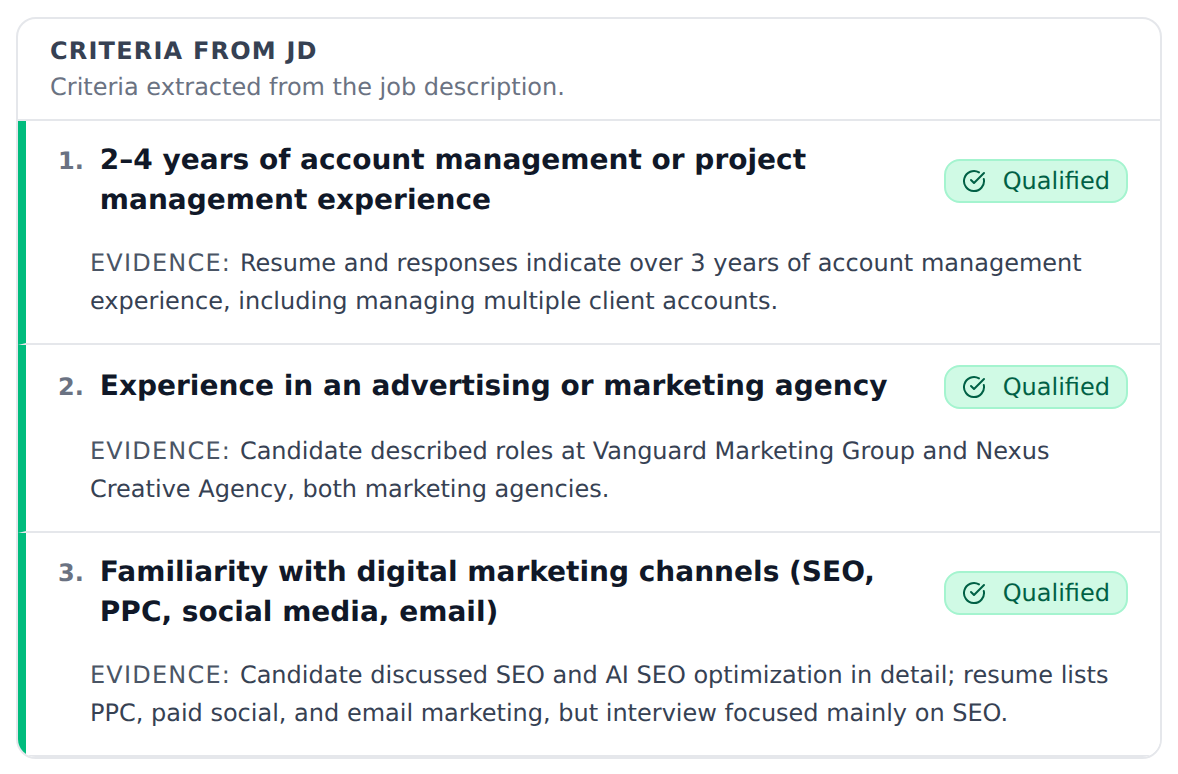
Good questions are only half the job. VeraHire turns the job description into explicit criteria, then scores every candidate's answer against them — with the evidence cited, so the score is auditable instead of a gut feeling.
When you run a sales rep interview, VeraHire extracts the must-have criteria from your job description — discovery rigor, objection handling, pipeline discipline, quota track record — and marks each one Qualified or Not Qualified based on what the candidate actually said. Every verdict links back to the exact moment in the transcript that supports it, so a sales manager can verify the call in seconds rather than re-listening to a recording.
Compensation snapshot
What does a wholesale sales rep typically cost?
Pay varies widely by region, industry, product line, and seniority — and base is only part of the story when commission and OTE are involved. Use the range below to sanity-check your budget, then confirm against an authoritative source before you post.
$66,780
median US wage / year (BLS, 2024)
The US median wage for sales representatives, wholesale and manufacturing (except technical and scientific products) is $66,780 per year (about $32.10 per hour) as of May 2024. Most fall between roughly $37,860 and $134,470 (10th–90th percentile) — newer reps and lower-ticket product lines toward the lower end, and seasoned reps with large, complex territories toward the higher end.
One caveat specific to sales: most of these roles pay base plus commission, so total on-target earnings (OTE) can sit well above base. Treat these as planning figures — actual market rates shift by city, industry, and commission structure.
Source: U.S. Bureau of Labor Statistics, OEWS — May 2024
Avoid these
Common mistakes when hiring sales reps
Most bad sales hires trace back to the same handful of screening shortcuts.
- i.Hiring the best talker in the room. Charisma in an interview is not the same as discovery, qualification, and the discipline to close. Smooth ≠ effective.
- ii.Trusting self-reported quota numbers. Anyone can say they were "President's Club." Ask for the actual quota, attainment percentage, and what they personally did to hit it.
- iii.Over-valuing an existing Rolodex. A book of contacts fades fast and rarely transfers. Process and territory-building skill outlast any one list.
- iv.Skipping a role-play or real-deal walkthrough. If you never watch them handle an objection or break down a deal, you're guessing at the most important skill.
- v.Ignoring pipeline discipline and CRM hygiene. Reps who can't forecast or keep a clean pipeline cost you blown quarters and bad planning, no matter how well they sell.
- vi.Inconsistent scoring. Without shared criteria, two interviewers rate the same answer differently — and bias fills the gap.
Try it on your role
Generate a free first-round interview for your sales rep role
Paste your job description, get a structured sales rep interview with built-in scoring criteria, and start ranking real candidates in minutes — no ATS required.
FAQ
Hiring a sales rep: quick answers
What skills matter most when hiring a wholesale & manufacturing sales rep?
Discovery and qualification, objection handling, negotiation, pipeline discipline, and a verifiable quota track record. Product knowledge matters too, but it's far more teachable than sales instinct and resilience — so weight the selling skills and self-discipline highest, and confirm the numbers rather than taking them on faith.
Does a sales rep need experience in my specific industry?
Often less than you'd think. Strong reps transfer across industries because discovery, qualification, and closing are the same everywhere, and most product and market knowledge can be learned in a few months. Prioritize selling skill and coachability over an exact industry match — unless the sales cycle is highly technical, in which case some domain fluency helps.
How long does it take to hire a wholesale & manufacturing sales rep?
Typically about three to six weeks from posting to offer, depending on your applicant flow and how many interview rounds you run. The slowest step is usually first-round screening and reference checks — running structured, automatically scored interviews up front compresses that significantly and helps you skip the smooth talkers early.
What interview questions actually reveal a great sales rep?
Past-deal questions beat hypotheticals. Ask how they qualified their last big deal, what they said when a buyer pushed back on price, a deal they were sure they'd win and lost, and their actual quota and attainment. Listen for honest numbers, ownership of losses, and pipeline discipline — and probe with a follow-up on each.