"Tell me about a time you faced an aggressive or intoxicated person on a post. Walk me through exactly what you said and did."
VeraHire Hiring GuidesSecurity GuardUpdated 2026
How to hire a Security Guard in 2026
TL;DR
Great security guards are made of vigilance, sound judgment, and composure under pressure — not resume keywords. The fastest way to find them is to verify the license, stop asking hypotheticals, and start asking for real past behavior, then score every answer against the same criteria. Below are the 8 interview questions that actually predict guard performance, what to listen for, the red flags, and how VeraHire scores each one automatically.
The role, honestly
What a great Security Guard actually does
The job title hides how much judgment the work demands. A strong guard is part observer, part gatekeeper, part first responder — and spends most of the shift preventing the incident that never makes the report.
On paper a security guard "watches the premises." In practice they hold a post for hours while staying genuinely alert, notice the one detail that is out of place, decide in seconds whether something is a nuisance or a real threat, and control who comes and goes — all while staying calm enough that a tense moment doesn't turn into a dangerous one.
The best ones are deterrents first and enforcers last. They are visible, observant, and consistent, so most problems never start. When something does happen, they de-escalate before they confront, know exactly when a situation has crossed the line from their responsibility to the police's, and write up what happened clearly enough that it holds up later. Note that in nearly every US state, working as a guard requires a state license or "guard card" — and an armed post requires a separate firearms permit — so verifying credentials is step one, not an afterthought.
Patrol & observation
Hold a post or walk a route while staying genuinely alert, spotting what's out of place and deterring problems before they start.
Access control
Verify identity, check credentials and badges, manage visitor logs, and turn people away politely but firmly when the rules require it.
Incident response & de-escalation
Stay composed in a confrontation, talk the temperature down, and know exactly when a situation requires calling police or emergency services.
Reporting & documentation
Write accurate, timely incident reports and daily logs — factual enough to stand up to a manager, an insurer, or a court.
The unique data
The interview questions that actually predict performance
Eight guard-specific questions built around past behavior, not hypotheticals. For each one: what to listen for, the red flag that should worry you, and a follow-up probe to pressure-test the answer.
"Overnight posts are quiet for hours. Tell me about a real night you had to stay sharp when nothing was happening — how did you do it?"
"Describe a real situation where you had to decide whether to handle something yourself or escalate to law enforcement. What did you choose and why?"
"Tell me about an incident report you wrote. What did you include, what did you leave out, and why?"
"A senior employee or an angry visitor insists on entering without proper credentials. Tell me about a time you had to enforce a rule on someone who outranked or intimidated you."
"Have you ever been offered something — money, a favor, a look the other way — to ignore a rule on a post? What happened?"
"Tell me about a real emergency on your watch — a fire alarm, a medical event, an intrusion. What did you do in the first two minutes?"
"Posts depend on someone actually showing up, on time, fit for duty. Tell me about your attendance record and walk me through your current license status."
Evidence-based scoring
How VeraHire scores each answer
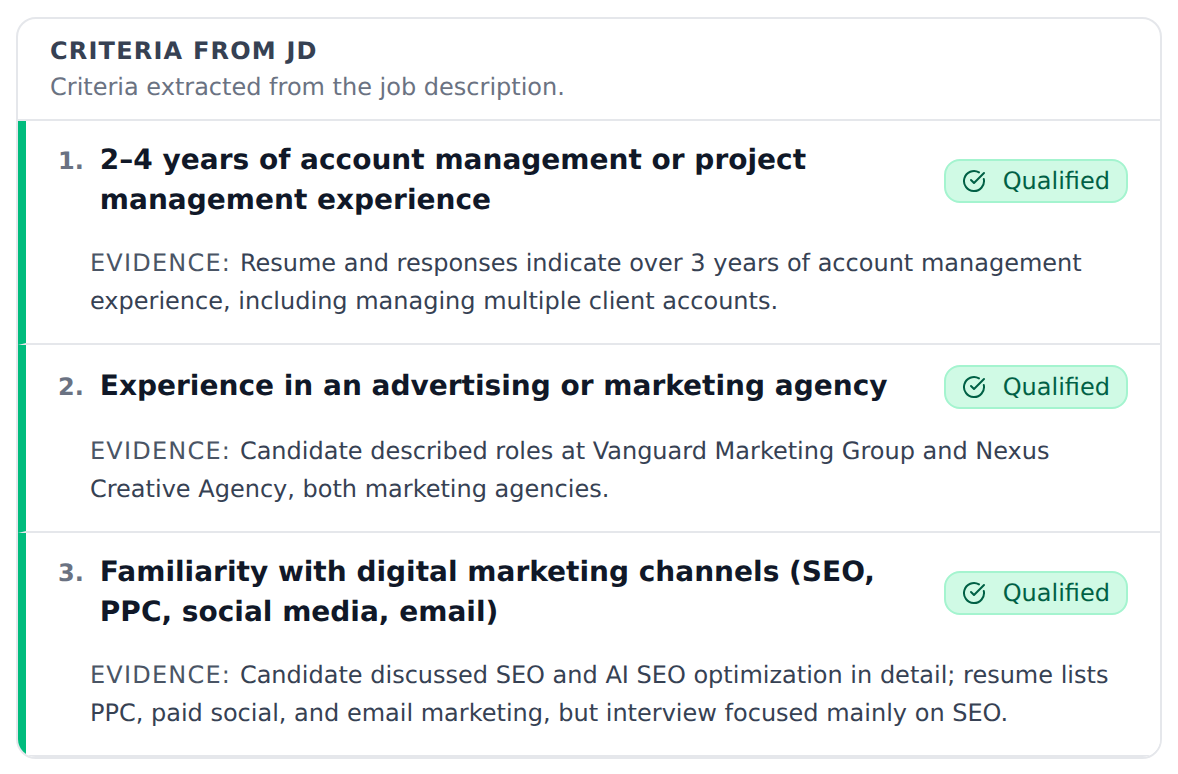
Good questions are only half the job. VeraHire turns the job description into explicit criteria, then scores every candidate's answer against them — with the evidence cited, so the score is auditable instead of a gut feeling.
When you run a security guard interview, VeraHire extracts the must-have criteria from your job description — valid license, de-escalation, sound judgment on when to escalate, observation and reporting, reliability — and marks each one Qualified or Not Qualified based on what the candidate actually said. Every verdict links back to the exact moment in the transcript that supports it, so a hiring manager can verify the call in seconds rather than re-listening to a recording.
Compensation snapshot
What does a security guard typically cost?
Pay varies widely by region, industry, post type, and whether the role is armed. Use the range below to sanity-check your budget — then confirm against an authoritative source before you post.
$38,370
median US wage / year (BLS, 2024)
The US median wage for security guards is $38,370 per year (about $18.46 per hour) as of May 2024. Most fall between roughly $29,800 and $59,580 (10th–90th percentile) — entry-level retail and unarmed posts toward the lower end, and armed, specialized, or supervisory roles toward the higher end.
Treat these as planning figures — actual market rates shift by city, industry, and year, and armed posts, overnight differentials, and union sites change the math entirely.
Source: U.S. Bureau of Labor Statistics, OEWS — May 2024
Avoid these
Common mistakes when hiring security guards
Most bad guard hires trace back to the same handful of screening shortcuts.
- i.Not verifying the license or guard card. Most states require a valid guard license — and a separate firearms permit for armed posts. Confirm it's current before anything else; an unlicensed guard is a legal liability.
- ii.Never testing de-escalation. If no question puts the candidate in a confrontation scenario, you learn nothing about whether they'll talk a situation down or escalate it.
- iii.Ignoring reliability and attendance. An unmanned post is a real exposure. A pattern of no-shows matters more here than almost any other trait.
- iv.Skipping the integrity check. Guards work unsupervised around cash, keys, and access. If you never probe honesty, you're trusting on faith.
- v.Asking only hypotheticals. "What would you do if…" rewards good talkers. "Tell me about a time…" reveals how someone actually behaved on a real post.
- vi.Inconsistent scoring. Without shared criteria, two interviewers rate the same answer differently — and bias fills the gap.
Try it on your role
Generate a free first-round interview for your guard role
Paste your job description, get a structured security guard interview with built-in scoring criteria, and start ranking real candidates in minutes — no ATS required.
FAQ
Hiring a security guard: quick answers
Does a security guard need a license to work?
In nearly every US state, yes. Unarmed guards typically need a state-issued license or "guard card," and armed guards need a separate firearms permit on top of it. Requirements, training hours, and renewal periods vary by state, so always verify the candidate's credential is current and valid for the post type before hiring — it's a legal requirement, not a nice-to-have.
What skills matter most when hiring a security guard?
Vigilance and observation, calm de-escalation, sound judgment on when to escalate to police, clear incident reporting, integrity when unsupervised, and plain reliability. Many of these are more about temperament than experience — so weight composure, judgment, and honesty highest, and verify the license separately.
What interview questions actually reveal a great security guard?
Past-behavior questions beat hypotheticals. Ask for a specific time they de-escalated an aggressive person, how they stay alert on a quiet overnight shift, a real decision about whether to call police, and what they put in an incident report. Listen for composure, judgment, and honesty — and probe with a follow-up on each.
How long does it take to hire a security guard?
For unarmed posts it often runs about one to three weeks from posting to offer, depending on applicant flow and how fast you verify licenses. The slowest steps are usually license verification and first-round screening — running structured, automatically scored interviews up front compresses the screening significantly.