"Tell me about a rep on your team who was missing quota. Walk me through exactly what you did, week by week, and how it ended."
VeraHire Hiring GuidesSales ManagerUpdated 2026
How to hire a Sales Manager in 2026
TL;DR
A great sales manager wins through other people — by coaching reps, forecasting honestly, and building a team that hits quota without them carrying every deal. That skill set is almost invisible on a resume, and your best individual seller is not automatically your best manager. The fastest way to find the real thing is to stop asking how they sell and start asking for the times they made someone else sell better. Below are the 8 interview questions that predict sales-management performance, what to listen for, the red flags, and how VeraHire scores each one automatically.
The role, honestly
What a great Sales Manager actually does
The title sounds like "the best salesperson, promoted." It isn't. A strong manager is part coach, part forecaster, part recruiter, part strategist — and the job is leverage, not personal output.
On paper a sales manager "leads the sales team and hits the number." In practice the number is hit by the reps, and the manager's job is to make those reps measurably better than they would be alone. That means sitting in on calls and giving specific feedback, inspecting the pipeline deal by deal, forecasting a quarter the executive team can actually plan against, and removing the obstacles that keep good sellers from closing.
This is a different job from being a quota-crushing rep, and the distinction matters enormously when you hire. The best individual closer often relies on instincts they can't teach and a hands-on style that doesn't scale past their own calendar. A great manager, by contrast, can diagnose why a rep is stalling, name the one behavior to change, and resist the urge to simply grab the deal and close it themselves. They build a repeatable motion instead of a personal hot streak — and they're judged on the whole team's attainment, not their own.
Coach and develop reps
Run call reviews and deal coaching that change behavior, ramp new hires fast, and lift the middle of the team — not just celebrate the top performer.
Own pipeline and forecasting
Inspect every deal, qualify ruthlessly, and call a number leadership can plan around — catching slippage early instead of explaining the miss after the quarter closes.
Hire and set quota
Recruit, interview, and onboard their own reps, then set quotas and territories that are fair, motivating, and tied to a realistic capacity model.
Set strategy and align cross-functionally
Translate the revenue target into a territory and segment plan, and work with marketing, RevOps, and product so the team isn't fighting the system to sell.
The unique data
The interview questions that actually predict performance
Eight sales-manager-specific questions built around past behavior, not hypotheticals — and built around managing, not personal selling. For each one: what to listen for, the red flag that should worry you, and a follow-up probe to pressure-test the answer.
"How did you build and inspect your team's pipeline, and how close were your forecasts to what actually closed?"
"A rep is about to lose a deal you know you could close yourself. Walk me through what you actually did the last time this happened."
"Tell me about the hardest decision you made to put someone on a plan or let them go. How did you handle it?"
"Describe a quarter where the team was tracking well behind plan. What did you do, and what was the result?"
"Tell me about a rep you hired who worked out — and one who didn't. What did you screen for, and what did you get wrong?"
"Stars usually take care of themselves. Tell me about a time you lifted a solid-but-average rep — what specifically did you change?"
"Tell me about a time the team's quota was at risk because of something outside the sales org — leads, pricing, product, process. What did you do?"
Evidence-based scoring
How VeraHire scores each answer
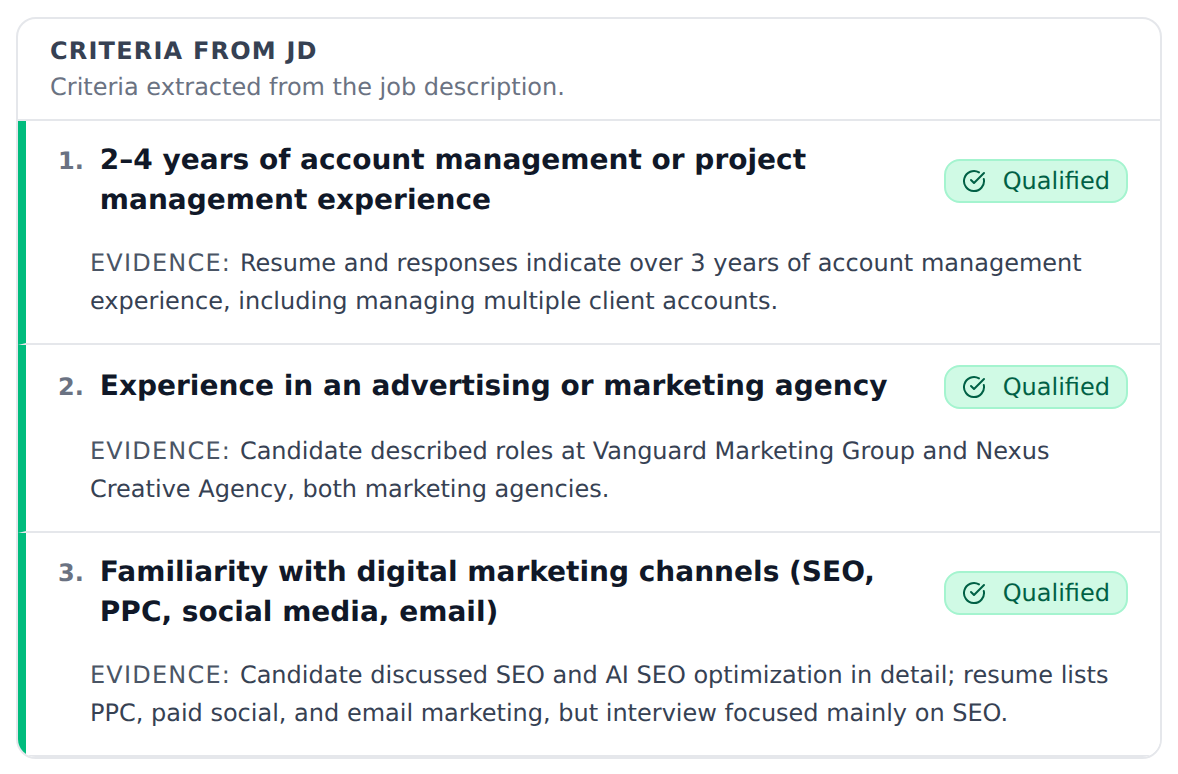
Good questions are only half the job. VeraHire turns the job description into explicit criteria, then scores every candidate's answer against them — with the evidence cited, so the score is auditable instead of a gut feeling.
When you run a sales-manager interview, VeraHire extracts the must-have criteria from your job description — coaching ability, forecast discipline, hiring judgment, cross-functional influence — and marks each one Qualified or Not Qualified based on what the candidate actually said. Every verdict links back to the exact moment in the transcript that supports it, so a hiring manager can tell a true coach from a great-talking super-rep in seconds rather than re-listening to a recording.
Compensation snapshot
What does a Sales Manager typically cost?
Pay varies widely by industry, deal size, region, and seniority — and for this role, on-target earnings can swing the number dramatically. Use the range below to sanity-check your budget, then confirm against an authoritative source before you post.
$138,060
median US wage / year (BLS, 2024)
The US median wage for sales managers is $138,060 per year as of May 2024. Most fall between roughly $66,910 and $239,200 (10th–90th percentile) — smaller regional or inside-sales teams toward the lower end, and enterprise or high-growth tech leadership toward the higher end.
One caveat specific to this role: total compensation is usually split between base salary and commission or bonus tied to team quota, so on-target earnings (OTE) frequently run well above base — and in high-performing orgs, above these published figures. Treat these as planning numbers and confirm OTE structure for your market.
Source: U.S. Bureau of Labor Statistics, OEWS — May 2024
Avoid these
Common mistakes when hiring sales managers
Most bad sales-management hires trace back to the same handful of screening shortcuts.
- i.Promoting your top rep without testing for management. Individual quota attainment predicts almost nothing about whether someone can coach, forecast, or lead. Test the management skills directly before you bet a whole team on them.
- ii.Never screening for coaching. If no question asks for a specific time they made another rep better, you've learned how well they sell — not how well they build sellers.
- iii.Using vague metrics. "Exceeded targets" means nothing without team attainment, forecast accuracy, ramp time, and retention. Ask for the numbers and how they were measured.
- iv.Being seduced by the demo. Sales managers interview for a living. A polished, charismatic conversation is table stakes — probe for real decisions and evidence underneath the delivery.
- v.Skipping the hard-decisions test. If you never ask about a PIP, a firing, or a missed quarter, you learn nothing about how they lead when the number is in danger — which is exactly when it matters.
- vi.Inconsistent scoring. Without shared criteria, two interviewers rate the same answer differently — and bias fills the gap.
Try it on your role
Generate a free first-round interview for your Sales Manager role
Paste your job description, get a structured sales-manager interview with built-in scoring criteria, and start ranking real candidates in minutes — no ATS required.
FAQ
Hiring a Sales Manager: quick answers
What skills matter most when hiring a sales manager?
Coaching ability, forecast discipline, hiring and onboarding judgment, and cross-functional influence — far more than personal selling skill. The job is leverage: making a whole team better and calling a number leadership can plan around. Weight the ability to develop others and inspect a pipeline above raw individual quota history.
Should I promote my best sales rep into management?
Only after you test for it. Top individual performance predicts very little about coaching, forecasting, or leadership, and the "super-rep" who can't stop closing deals themselves often makes a poor manager. Interview your internal candidate against the same management-specific questions you'd ask an external one, and look for evidence they've already made other people better.
How long does it take to hire a sales manager?
It typically runs about four to eight weeks from posting to offer — longer than an individual-contributor hire because the bar is higher and the cost of a mistake affects an entire team. The slowest step is usually screening for genuine management ability versus interview polish, which structured, automatically scored first-round interviews compress significantly.
What interview questions actually reveal a great sales manager?
Past-behavior questions about managing, not selling. Ask for a specific time they turned around an underperforming rep, how accurate their forecasts were and how they caught slippage, the hardest PIP or firing they handled, and a rep they hired who didn't work out. Listen for diagnosis, fairness, decisiveness, and a preference for coaching over taking the deal themselves — and probe each with a follow-up.