"Tell me about a time you turned a customer who was 'just looking' into a sale. What did you say, and how did you read that it was working?"
VeraHire Hiring GuidesRetail Sales AssociateUpdated 2026
How to hire a Retail Sales Associate in 2026
TL;DR
Great retail sales associates are made of warmth, hustle, and reliability — not resume keywords. The fastest way to find them is to stop asking hypotheticals and start asking for real past behavior on the floor, then score every answer against the same criteria. Below are the 8 interview questions that actually predict associate performance, what to listen for, the red flags, and how VeraHire scores each one automatically.
The role, honestly
What a great Retail Sales Associate actually does
The job title hides how much the floor demands. A strong associate is part host, part product expert, part cashier, part loss-prevention eyes — switching between all of them while the line keeps growing.
On paper a retail sales associate "assists customers and operates the register." In practice they read a shopper in the first ten seconds, turn a quiet "just looking" into a sale without being pushy, ring it up accurately, and keep the floor stocked and shoppable — often alone in their section during a rush.
The best ones make a busy store feel calm. They greet warmly without hovering, ask the question that surfaces what the customer actually came for, and know the merchandise well enough to suggest the right add-on instead of any add-on. They handle a return or a price dispute without it becoming a scene, watch for the things that walk out the door, and still show up for the Saturday shift they said they would.
Help and sell, not just point
Greet, qualify what the customer needs, and guide them to the right product — closing the sale and suggesting the natural add-on without being pushy.
Know the merchandise
Speak to features, sizing, fit, materials, and what's in stock or coming in, so a shopper trusts the recommendation instead of leaving to check online.
Run the register and watch the floor
Ring transactions, returns, and discounts accurately, handle cash and cards cleanly, and stay alert to the signals of shoplifting and shrink.
Stock, merchandise, and back the team
Keep shelves faced, fitting rooms clear, and displays set to plan — and pick up the slack for teammates when the store gets slammed.
The unique data
The interview questions that actually predict performance
Eight associate-specific questions built around past behavior, not hypotheticals. For each one: what to listen for, the red flag that should worry you, and a follow-up probe to pressure-test the answer.
"Tell me about an angry customer demanding a return or refund you weren't sure you could give. Walk me through exactly what you did."
"Describe a time you noticed possible shoplifting or a suspicious transaction. What did you do?"
"Pick a product you sold and 'sell' it to me — then tell me how you learned enough to recommend it confidently."
"It's a Saturday rush: a line at the register, a customer needs a fitting room, and the phone is ringing. How do you handle it?"
"Retail runs on nights, weekends, and holidays. Tell me about your real availability and a time your attendance was tested."
"Tell me about a time you suggested something extra and the customer was glad you did. How did you decide what to recommend?"
"Tell me about a time you covered for a teammate or stayed to close a messy store. What did you do without being asked?"
Evidence-based scoring
How VeraHire scores each answer
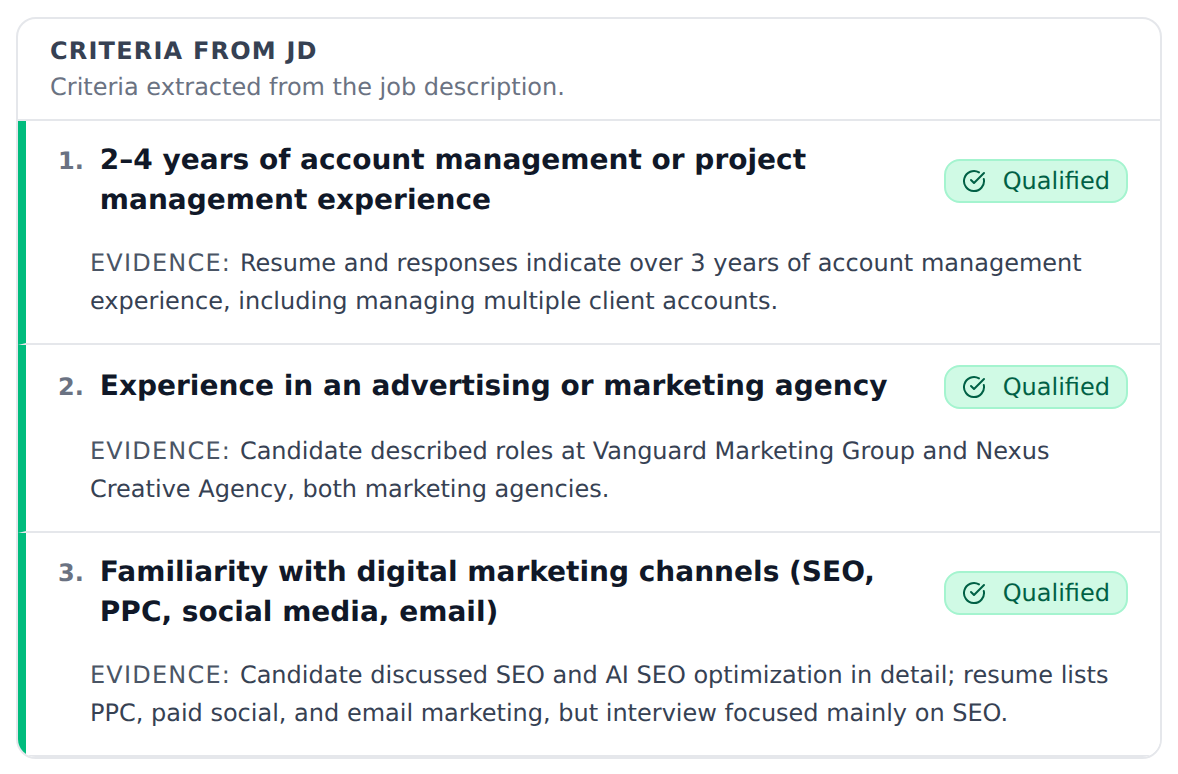
Good questions are only half the job. VeraHire turns the job description into explicit criteria, then scores every candidate's answer against them — with the evidence cited, so the score is auditable instead of a gut feeling.
When you run a retail sales associate interview, VeraHire extracts the must-have criteria from your job description — selling instinct, customer warmth, register accuracy, reliability — and marks each one Qualified or Not Qualified based on what the candidate actually said. Every verdict links back to the exact moment in the transcript that supports it, so a store manager can verify the call in seconds rather than re-listening to a recording.
Compensation snapshot
What does a retail sales associate typically cost?
Pay varies widely by region, store type, commission structure, and seniority. Use the range below to sanity-check your budget — then confirm against an authoritative source before you post.
$34,570
median US wage / year (BLS, 2024)
The US median wage for retail salespersons is $34,570 per year (about $16.62 per hour) as of May 2024. Most fall between roughly $25,600 and $47,900 (10th–90th percentile) — entry-level and seasonal floor roles toward the lower end, and commission-heavy or big-ticket selling (furniture, electronics, vehicles) toward the higher end.
Treat these as planning figures — actual market rates shift by city, store format, and year, and commission, spiffs, and employee discounts change the math entirely.
Source: U.S. Bureau of Labor Statistics, OEWS — May 2024
Avoid these
Common mistakes when hiring associates
Most bad retail hires trace back to the same handful of screening shortcuts.
- i.Rushing high-volume and seasonal hiring. When you need 30 bodies before the holidays, it's tempting to hire on a 10-minute chat — but a fast, structured screen catches the no-shows before they cost you a shift.
- ii.Not screening for reliability. Attendance and availability are the single biggest predictors of a good retail hire, yet most interviews never seriously test them.
- iii.Hiring for a friendly resume, not selling instinct. "Retail experience" tells you nothing about whether someone can actually read a customer and close a sale.
- iv.Asking only hypotheticals. "What would you do if…" rewards good talkers. "Tell me about a time on the floor…" reveals real behavior.
- v.Inconsistent scoring across stores. Without shared criteria, two managers rate the same candidate differently — and bias fills the gap, especially under hiring-season pressure.
- vi.Ignoring availability fit. A great associate who can't work nights, weekends, or peak season is the wrong hire for a schedule built on exactly those hours.
Try it on your role
Generate a free first-round interview for your associate role
Paste your job description, get a structured retail sales associate interview with built-in scoring criteria, and start ranking real candidates in minutes — no ATS required.
FAQ
Hiring an associate: quick answers
What skills matter most when hiring a retail sales associate?
Customer warmth, a genuine selling instinct, register and cash accuracy, awareness of loss prevention, and — above all — reliability. Product knowledge helps, but it's far more teachable than temperament and attendance, so weight people skills and dependability highest.
Do retail sales associates need prior experience?
Usually not much. The core traits — warmth, hustle, honesty, and showing up — transfer from almost any customer-facing job, and most product and POS training takes only days to a couple of weeks. Prioritize attitude, coachability, and real availability over an exact retail-category match.
How do I hire retail associates fast for a seasonal rush?
Standardize the screen so it scales: one structured, automatically scored first-round interview that every applicant takes. That lets you process a high volume in days instead of weeks, surface the reliable, customer-ready candidates first, and avoid the rushed gut-feel hires that lead to holiday no-shows.
What interview questions actually reveal a great associate?
Past-behavior questions beat hypotheticals. Ask for a specific time they turned a browser into a buyer, handled an angry return, spotted possible theft, or juggled a Saturday rush — and dig into their real availability. Listen for warmth, honesty, and dependability, and probe with a follow-up on each.