"Tell me about a time a guest sent a dish back. Walk me through exactly what you said and did from the moment they flagged it."
VeraHire Hiring GuidesRestaurant ServerUpdated 2026
How to hire a Restaurant Server in 2026
TL;DR
Great restaurant servers are made of warmth, composure, and floor sense — not a long resume. The fastest way to find them is to stop asking hypotheticals and start asking for real past behavior on a busy shift, then score every answer against the same criteria. Below are the 8 interview questions that actually predict server performance, what to listen for, the red flags, and how VeraHire scores each one automatically.
The role, honestly
What a great Restaurant Server actually does
The job title hides how demanding the work is. A strong server is part host, part salesperson, part air-traffic controller — switching between all three dozens of times an hour, on their feet, under a clock.
On paper a server "takes orders and brings food." In practice they read a table in seconds, set the pace of a meal, sell without sounding like they're selling, and hold five tables at different stages in their head at once — all while staying warm to a guest who has no idea the kitchen is eighty-six on the special.
The best ones make a packed Friday night look effortless. They greet within a minute, fire courses so nothing arrives cold or too soon, catch a wrong allergy before it leaves the pass, and turn a complaint into a regular. They know the menu cold, they communicate cleanly with the kitchen and bar, and they keep their section humming when they're slammed and a tray just went down behind them.
Own the guest experience
Greet warmly, read the table's mood and pace, recommend with genuine knowledge, and make every guest feel looked after from greeting to check.
Get the order right, on the POS
Enter orders accurately, log modifiers and allergies, fire courses in the right sequence, and run a clean, error-free check and payment.
Run the floor under a rush
Hold a full section at once, prioritize on the fly, stay composed when the dining room is full and the wait list is growing.
Work the line with kitchen & bar
Communicate clearly with the back of house and bartenders, handle 86'd items gracefully, and keep tickets moving without friction.
The unique data
The interview questions that actually predict performance
Eight server-specific questions built around past behavior, not hypotheticals. For each one: what to listen for, the red flag that should worry you, and a follow-up probe to pressure-test the answer.
"Describe your busiest shift ever — a full section, a wait at the door. How did you keep every table moving?"
"Tell me about a time you increased a check without the guest feeling pushed. What did you actually say?"
"Walk me through how you take an order for a four-top with two modifications and an allergy, and get it into the system clean."
"Tell me about a real disagreement you had with the kitchen or an expo during service. How did it end?"
"Tell me about a time a tip-out, a section assignment, or a split check felt unfair. What did you do?"
"Tell me about the most difficult guest you've served — rude, demanding, or impossible to please. What happened?"
"A double on a Saturday is eight-plus hours on your feet, non-stop. How do you stay sharp and friendly to the last table?"
Evidence-based scoring
How VeraHire scores each answer
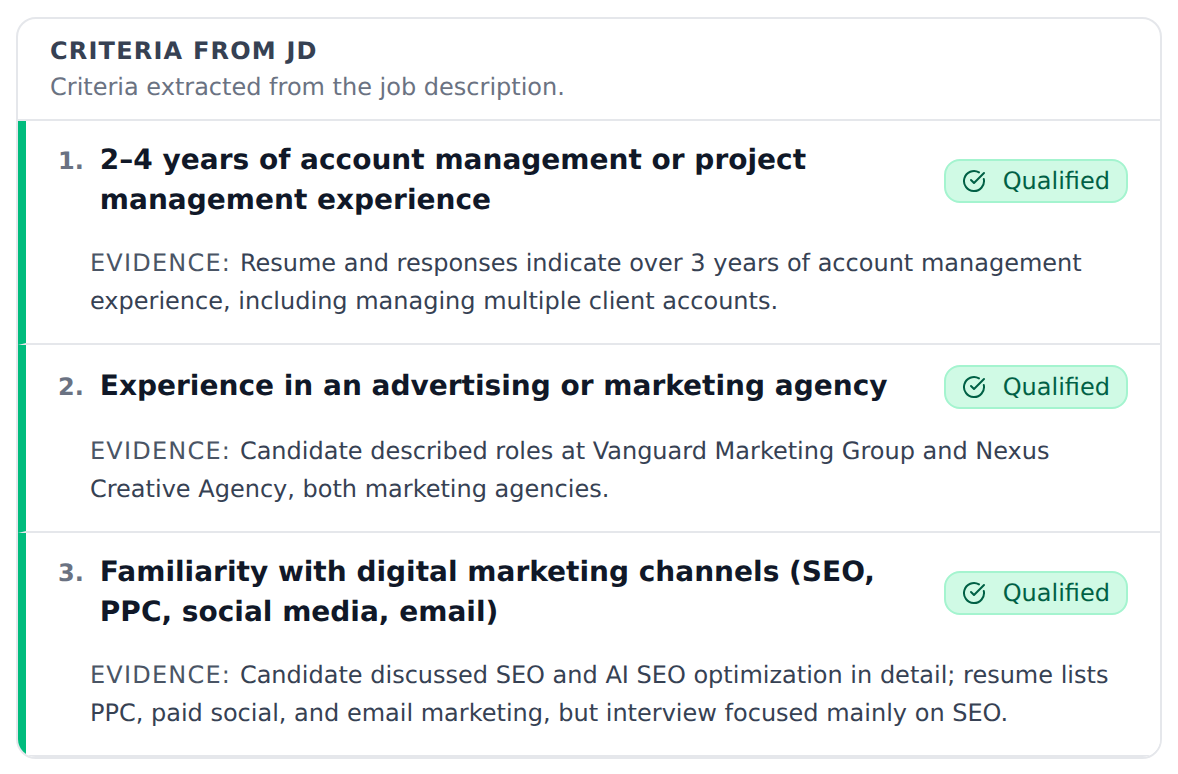
Good questions are only half the job. VeraHire turns the job description into explicit criteria, then scores every candidate's answer against them — with the evidence cited, so the score is auditable instead of a gut feeling.
When you run a server interview, VeraHire extracts the must-have criteria from your job description — guest service, composure under a rush, upselling, POS and order accuracy, teamwork with the kitchen — and marks each one Qualified or Not Qualified based on what the candidate actually said. Every verdict links back to the exact moment in the transcript that supports it, so a manager can verify the call in seconds rather than re-listening to a recording.
Compensation snapshot
What does a restaurant server typically cost?
Pay varies widely by region, restaurant type, shift mix, and how tips work. Use the range below to sanity-check your budget — then confirm against an authoritative source before you post.
$33,760
median US wage / year (BLS, 2024)
The US median wage for waiters and waitresses is $33,760 per year (about $16.23 per hour) as of May 2024. Most fall between roughly $18,500 and $62,500 (10th–90th percentile) — quick-service and casual spots toward the lower end, and busy fine-dining or high-volume rooms toward the higher end.
One caveat unique to this role: much of a server's take-home is tips, and reported figures don't always capture cash tips fully — so effective earnings can vary a lot night to night and house to house. Treat these as planning figures; actual market rates shift by city, concept, and tip structure.
Source: U.S. Bureau of Labor Statistics, OEWS — May 2024
Avoid these
Common mistakes when hiring servers
Most bad server hires trace back to the same handful of screening shortcuts.
- i.Rushing high-volume hiring. When you need ten servers before the weekend, it's tempting to hire anyone who can start Friday — and you pay for it in turnover a month later.
- ii.Over-weighting years of experience. "Five years serving" tells you nothing about whether they're warm with a difficult table. Menus are teachable; temperament isn't.
- iii.Skipping the trial shift. A great interview can still wilt on a real floor. A short stage shows you composure, pace, and how they treat the busser when no one's watching.
- iv.Asking only hypotheticals. "What would you do if a guest complained?" rewards good talkers. "Tell me about a time a dish came back" reveals real behavior.
- v.Ignoring availability and reliability. The best server in the world is no use if they can't work Friday and Saturday nights — confirm prime-shift availability before you fall in love with a candidate.
- vi.Inconsistent scoring. Without shared criteria, two managers rate the same answer differently — and bias fills the gap.
Try it on your role
Generate a free first-round interview for your server role
Paste your job description, get a structured server interview with built-in scoring criteria, and start ranking real candidates in minutes — no ATS required.
FAQ
Hiring a server: quick answers
What skills matter most when hiring a restaurant server?
Warmth and genuine guest focus, composure under a rush, accuracy on the POS, natural upselling, and clean teamwork with the kitchen and bar. Menu and system knowledge matter too, but they're far more teachable than temperament — so weight personality, composure, and reliability highest.
Does a server need prior fine-dining experience?
Usually not. The core skills — reading a table, staying calm when slammed, and being genuinely warm — transfer across concepts. A strong casual-dining server can be trained on fine-dining steps of service in a few shifts, so prioritize attitude, hustle, and coachability over an exact pedigree match.
How long does it take to hire a restaurant server?
It's often fast — many restaurants go from posting to a trial shift within a week, especially for high-volume hiring. The slowest step is usually screening a large applicant pool, so running structured, automatically scored first-round interviews up front lets you get the right people onto a stage shift much sooner.
What interview questions actually reveal a great server?
Past-behavior questions beat hypotheticals. Ask for a specific time a guest sent a dish back, how they ran their busiest shift, when they upsold without being pushy, and a real disagreement with the kitchen. Listen for warmth, composure, ownership, and teamwork — and probe with a follow-up on each.