"Tell me about a patient who was deteriorating before the numbers showed it. What did you notice, and what did you do?"
VeraHire Hiring GuidesRegistered NurseUpdated 2026
How to hire a Registered Nurse in 2026
TL;DR
Great registered nurses are made of clinical judgment, vigilance, and steadiness under pressure — not a tidy resume. A license and an NCLEX pass are the floor; they tell you a candidate can practice, not how they think when a patient is quietly deteriorating. The fastest way to find the strong ones is to stop asking hypotheticals and start asking for real bedside behavior, then score every answer against the same criteria. Below are the 8 interview questions that actually predict RN performance, what to listen for, the red flags, and how VeraHire scores each one automatically.
The role, honestly
What a great Registered Nurse actually does
The job title hides how much judgment the work demands. A strong RN is part clinician, part detective, part advocate, part teacher — shifting between all four many times in a single shift.
On paper an RN "provides patient care." In practice they assess a person head to toe, notice the small change a monitor hasn't flagged yet, and decide — often in seconds — whether something is fine, worth watching, or an emergency. They give medications safely, titrate them, catch the order that doesn't add up, and document all of it accurately while three other patients also need them. Every registered nurse on your floor must hold an active state RN license and have passed the NCLEX-RN; specialty units add their own certifications (ACLS, PALS, CCRN, and others) on top.
The best ones make a chaotic shift feel controlled. They prioritize ruthlessly when everyone needs something at once, speak up when a plan looks wrong even to a physician, and explain a frightening diagnosis to a family in plain, kind language. They are vigilant without being alarmist, fast without being careless, and they hand off a patient so cleanly that the next nurse misses nothing.
Assess and deliver care
Perform thorough patient assessments, administer and monitor treatments and medications, and adjust the plan as a patient's condition changes through the shift.
Exercise clinical judgment & safety
Recognize early signs of deterioration, prioritize across a full patient load, and act fast — escalating, intervening, or catching an error before it reaches the patient.
Communicate with empathy
Explain conditions, medications, and next steps so patients and anxious families truly understand — and listen well enough to surface concerns no one charted.
Chart and work as a team
Document accurately in the EHR, give and receive clean handoffs, and coordinate with physicians, techs, and pharmacy so nothing falls through the cracks.
The unique data
The interview questions that actually predict performance
Eight RN-specific questions built around real past behavior, not hypotheticals. For each one: what to listen for, the red flag that should worry you, and a follow-up probe to pressure-test the answer.
"Tell me about a time you pushed back on a physician or a plan of care because you believed it wasn't right for the patient."
"Walk me through a time you caught a medication error — your own or someone else's — before it reached the patient."
"Tell me about a time you had to deliver hard news to a patient or family, or calm one that was angry or terrified."
"You have four or five patients and they all need you at once. Tell me about a real shift like that and how you decided what came first."
"Describe a handoff that went wrong, or one you had to fix. What broke down, and what do you do now to prevent it?"
"Take me through the last time a patient coded or rapidly crashed while you were responsible for them. What was your role?"
"Nursing means loss, short staffing, and back-to-back demanding shifts. Tell me about your hardest stretch and how you kept your standards."
Evidence-based scoring
How VeraHire scores each answer
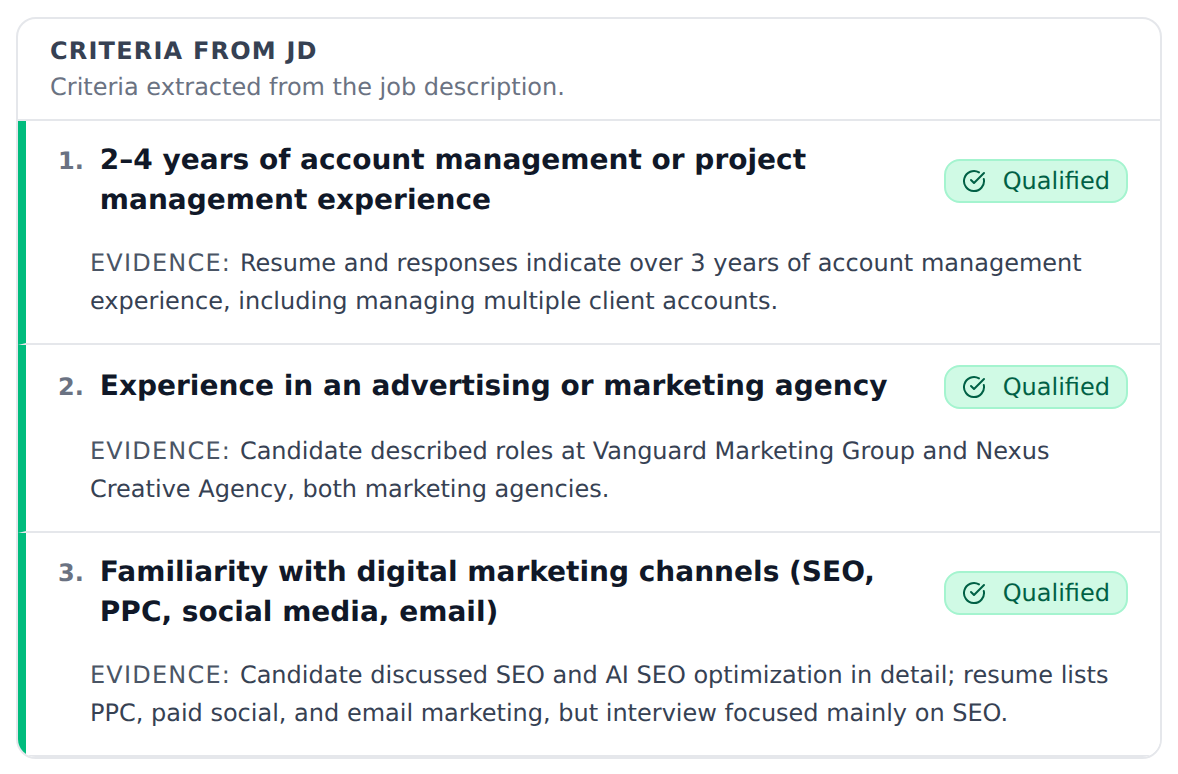
Good questions are only half the job. VeraHire turns the job description into explicit criteria, then scores every candidate's answer against them — with the evidence cited, so the score is auditable instead of a gut feeling.
When you run an RN interview, VeraHire extracts the must-have criteria from your job description — clinical judgment, medication safety, patient and family communication, teamwork, and the specialty or licensure requirements you set — and marks each one Qualified or Not Qualified based on what the candidate actually said. Every verdict links back to the exact moment in the transcript that supports it, so a nurse manager can verify the call in seconds rather than re-listening to a recording.
Compensation snapshot
What does a Registered Nurse typically cost?
Pay varies widely by region, specialty, shift differential, and experience. Use the range below to sanity-check your budget — then confirm against an authoritative source before you post.
$93,600
median US wage / year (BLS, 2024)
The US median wage for registered nurses is $93,600 per year (about $45.00 per hour) as of May 2024. Most fall between roughly $66,030 and $135,320 (10th–90th percentile) — newer nurses and lower-cost regions toward the lower end, and experienced, specialized, or high-cost-of-living roles (ICU, OR, travel, California metros) toward the higher end.
Treat these as planning figures — actual market rates shift sharply by state, specialty, and shift, and night, weekend, and critical-care differentials change the math meaningfully.
Source: U.S. Bureau of Labor Statistics, OEWS — May 2024
Avoid these
Common mistakes when hiring nurses
Most regretted RN hires trace back to the same handful of screening shortcuts.
- i.Not verifying the license and specialty. Confirm an active, unencumbered RN license through the state board (and Nursys), plus the specialty certifications the unit actually requires — before, not after, the offer.
- ii.Hiring on years, not judgment. "Ten years on a med-surg floor" tells you nothing about how someone reads a deteriorating patient. Screen for clinical reasoning directly.
- iii.Ignoring bedside manner. Patients and families remember how a nurse made them feel. Skip empathy and communication at your peril — it drives satisfaction scores and complaints alike.
- iv.Mismatching shift and setting fit. A great clinic nurse may struggle on nights in the ICU. Be explicit about shift, pace, acuity, and ratios, and screen for genuine fit.
- v.Asking only hypotheticals. "What would you do if a patient coded?" rewards good talkers. "Tell me about the last time one did" reveals what they actually did.
- vi.Inconsistent scoring. Without shared criteria, two interviewers rate the same answer differently — and bias fills the gap on a safety-critical hire.
Try it on your role
Generate a free first-round interview for your RN role
Paste your job description, get a structured registered nurse interview with built-in scoring criteria, and start ranking real candidates in minutes — no ATS required.
FAQ
Hiring a Registered Nurse: quick answers
What licenses and certifications does a registered nurse need?
Every RN must hold an active, unencumbered registered nurse license in your state and have passed the NCLEX-RN. Verify the license through the state board of nursing or Nursys, and confirm whether your unit requires extras such as BLS, ACLS, PALS, or specialty certifications like CCRN. Treat licensure as the floor, not the deciding factor.
Does a nurse need experience in my specialty to be a strong hire?
It depends on the acuity. High-stakes units like ICU, ED, and OR usually need relevant experience or a structured residency, while many med-surg, clinic, and outpatient roles can take a strong nurse from an adjacent area and train them up. Core clinical judgment, vigilance, and communication transfer; specialty protocols can be taught faster than temperament.
How long does it take to hire a registered nurse?
In a tight market it often runs three to six weeks from posting to a signed offer, and longer once you add license verification, references, and onboarding. The slowest steps are usually first-round screening and credential checks — running structured, automatically scored interviews up front compresses the screening time significantly.
What interview questions actually reveal a great nurse?
Past-behavior questions beat hypotheticals. Ask for a specific time they caught a deteriorating patient early, advocated for a patient against the plan of care, caught a medication error, or stayed composed during a code. Listen for clinical reasoning, ownership, safety habits, and empathy — and probe with a follow-up on each.