"Tell me about a time a visitor arrived flustered, early, or in the wrong place. How did you greet them and turn it around?"
VeraHire Hiring GuidesReceptionistUpdated 2026
How to hire a Receptionist in 2026
TL;DR
A great receptionist is the first face and voice of your company — warm under pressure, organized when the lobby and the phones go off at once, and discreet with everything they overhear. None of that shows up on a resume. The fastest way to find it is to stop asking hypotheticals and start asking for real past behavior, then score every answer against the same criteria. Below are the 8 interview questions that actually predict receptionist performance, what to listen for, the red flags, and how VeraHire scores each one automatically.
The role, honestly
What a great Receptionist actually does
The job title sounds simple, but the front desk is where a dozen small jobs collide. A strong receptionist is part host, part switchboard, part scheduler, part gatekeeper — often all four inside a single minute.
On paper a receptionist "greets visitors and answers phones." In practice they set the tone for everyone who walks in or calls, route a stranger's half-formed request to exactly the right person, and keep a calendar, a sign-in log, and a ringing phone all moving without dropping any of them. They do it in full view of clients, with a smile that has to survive the eightieth interruption of the day.
The best ones make a busy lobby feel calm. They remember a returning client's name, take a clean phone message instead of a vague one, and know when a "quick question" at the desk needs to wait three seconds while they put a caller on hold. They're trusted with deliveries, badges, signed NDAs, and the occasional upset visitor — and they handle the confidential things they overhear as if they never heard them.
Own the first impression
Greet every visitor warmly and promptly, look up from the screen, and make a stranger feel expected — because the front desk is the company's handshake.
Run the phones cleanly
Answer quickly, screen and route calls to the right person, and take accurate, complete messages instead of "someone called about something."
Manage the calendar and the lobby
Book and confirm appointments, sign visitors in, issue badges, alert the host, and keep meeting rooms and deliveries flowing on time.
Multitask without dropping a ball
Hold a friendly tone while juggling a walk-in, a ringing line, and an inbox — and stay discreet with everything said and seen at the desk.
The unique data
The interview questions that actually predict performance
Eight receptionist-specific questions built around past behavior, not hypotheticals. For each one: what to listen for, the red flag that should worry you, and a follow-up probe to pressure-test the answer.
"Walk me through how you answer and route a call when the caller is vague about who they need and the person they want is unavailable."
"Tell me about an angry or upset visitor or caller you dealt with at the desk. What did you actually say and do?"
"Describe your busiest hour at a front desk — phones, walk-ins, deliveries, messages all at once. How did you keep it from falling apart?"
"How have you managed appointments or meeting rooms? Tell me about a double-booking or scheduling mess you had to fix."
"Tell me about a time you had to verify, screen, or turn away a visitor — or handle something confidential at the desk."
"A visitor or caller needs an answer, the person who handles it is out, and you're not sure of the policy. What do you do?"
"The front desk means being 'on' and friendly from open to close, even on a bad day. How do you keep your tone consistent by the afternoon?"
Evidence-based scoring
How VeraHire scores each answer
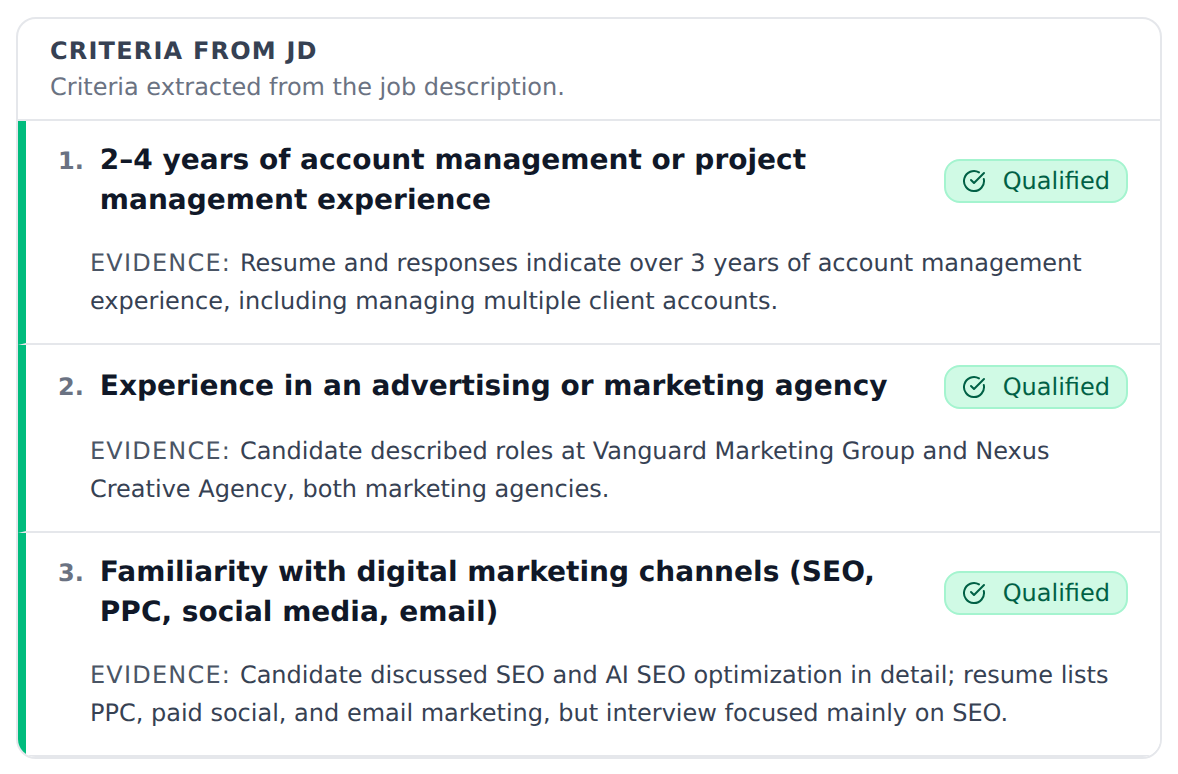
Good questions are only half the job. VeraHire turns the job description into explicit criteria, then scores every candidate's answer against them — with the evidence cited, so the score is auditable instead of a gut feeling.
When you run a receptionist interview, VeraHire extracts the must-have criteria from your job description — warm first impressions, phone and call-routing skill, multitasking under interruption, scheduling, and discretion — and marks each one Qualified or Not Qualified based on what the candidate actually said. Every verdict links back to the exact moment in the transcript that supports it, so a hiring manager can verify the call in seconds rather than re-listening to a recording.
Compensation snapshot
What does a receptionist typically cost?
Pay varies widely by region, industry, and whether the role is purely front-desk or blended with admin work. Use the range below to sanity-check your budget — then confirm against an authoritative source before you post.
$37,230
median US wage / year (BLS, 2024)
The US median wage for receptionists and information clerks is $37,230 per year (about $17.90 per hour) as of May 2024. Most fall between roughly $28,300 and $48,900 a year ($13.60–$23.49 per hour, 10th–90th percentile) — entry-level and small-office front desks toward the lower end, and medical, legal, or corporate roles with added admin or bilingual duties toward the higher end.
Treat these as planning figures — actual market rates shift by city, industry, and year, and high cost-of-living metros run well above the national median.
Source: U.S. Bureau of Labor Statistics, OEWS — May 2024
Avoid these
Common mistakes when hiring receptionists
Most disappointing receptionist hires trace back to the same handful of screening shortcuts.
- i.Hiring on "people-person" vibes alone. A warm interview chat doesn't prove someone can stay warm at 4 p.m. with three lines ringing. Test composure, not just charm.
- ii.Never testing the phone. The desk lives on the phone, yet most interviews never hear the candidate greet a caller, screen a request, or take a message.
- iii.Ignoring multitasking under pressure. If no question forces them to juggle a walk-in and a ringing line, you learn nothing about their actual busy hour.
- iv.Overlooking discretion. Receptionists overhear and see a lot. Skip the confidentiality question and you may not find out until it's a problem.
- v.Asking only hypotheticals. "What would you do if…" rewards good talkers. "Tell me about a time…" reveals how they really handled a packed lobby.
- vi.Inconsistent scoring. Without shared criteria, two interviewers rate the same candidate differently — and first-impression bias quietly fills the gap.
Try it on your role
Generate a free first-round interview for your receptionist role
Paste your job description, get a structured receptionist interview with built-in scoring criteria, and start ranking real candidates in minutes — no ATS required.
FAQ
Hiring a receptionist: quick answers
What skills matter most when hiring a receptionist?
A warm, professional manner in person and on the phone, clear communication, strong multitasking under interruption, organization for scheduling and messages, and discretion with confidential information. Software and front-desk procedures are easy to teach; composure and genuine hospitality are not — so weight temperament and communication highest.
Does a receptionist need prior front-desk experience?
Not necessarily. Many excellent receptionists come from retail, hospitality, or any customer-facing job, because the core skills — staying friendly under pressure, juggling tasks, and handling people well — transfer directly. Phones, scheduling tools, and visitor procedures can be learned in days, so prioritize aptitude and attitude over an exact title match.
How long does it take to hire a receptionist?
It often runs about two to three weeks from posting to offer, since the applicant pool is usually large. The slowest step is first-round screening — sorting many friendly-sounding resumes down to people who can actually run a busy desk. Running structured, automatically scored phone-style interviews up front compresses that significantly.
What interview questions actually reveal a great receptionist?
Past-behavior questions beat hypotheticals. Ask for a specific time they greeted a flustered visitor, how they routed a vague call when the right person was out, how they handled an angry guest in front of others, and how they kept a busy hour of phones and walk-ins from falling apart. Listen for warmth, composure, and ownership — and probe with a follow-up on each.