"Tell me about a process that was clearly broken when you inherited it. How did you diagnose the real problem, and what did you change?"
VeraHire Hiring GuidesOperations ManagerUpdated 2026
How to hire an Operations Manager in 2026
TL;DR
A great operations manager is judged on outcomes, not job titles — did throughput go up, did costs come down, did the team get better? The fastest way to find one is to stop asking how they'd run a perfect process and start asking what they actually fixed, cut, or shipped under real constraints, then score every answer against the same bar. Below are the 8 interview questions that predict operations-manager performance, what to listen for, the red flags, and how VeraHire scores each one automatically.
The role, honestly
What a great Operations Manager actually does
The title spans a warehouse floor, a clinic, a SaaS back office, and a restaurant group. The constant: someone who turns a messy, resource-constrained reality into a system that runs without them in the room.
On paper an operations manager "oversees daily operations." In practice they own the gap between what the business promised and what it can actually deliver — staffing the floor, holding the budget, unblocking the team, and absorbing the surprises that no plan survived. They live at the intersection of people, process, and numbers, and they're accountable for all three at once.
The best ones make the organization calmer, not busier. They find the one bottleneck that's throttling everything else instead of optimizing ten things that don't matter. They build a rhythm — standups, metrics, escalation paths — so problems surface early and decisions don't all funnel through them. And they can switch in the same hour from coaching a struggling supervisor to defending a number to the CFO.
Fix processes that scale
Find the real bottleneck, redesign the workflow around it, and standardize it so quality and throughput hold even as volume grows.
Lead, staff, and develop a team
Hire and schedule the right people, coach supervisors, and make the hard performance calls — keeping the floor running through turnover and change.
Own the budget and the metrics
Manage a P&L or cost center, defend headcount, and move the numbers that matter — output, cost per unit, on-time rate, margin.
Execute across functions
Coordinate with finance, sales, supply chain, and frontline teams so a decision in one place doesn't quietly break something in another.
The unique data
The interview questions that actually predict performance
Eight operations-manager-specific questions built around past behavior, not hypotheticals. For each one: what to listen for, the red flag that should worry you, and a follow-up probe to pressure-test the answer.
"Describe a time you had to roll out an unpopular change — a new system, schedule, or standard — to a team that pushed back. How did you get adoption?"
"Tell me about the toughest performance or staffing decision you've made — someone you had to manage out, or a role you had to cut. Walk me through it."
"Tell me about a time you had to hit a demanding target — output, deadline, or cost — with fewer people or resources than you needed. What did you actually do?"
"When everything is on fire on a Monday morning, how do you decide what gets your attention first? Give me a recent real example."
"What budget or P&L have you owned, and tell me about a time you had to bring a cost down or defend your spend to finance."
"Tell me about a goal you couldn't hit alone — where you depended on sales, finance, or supply chain. How did you get a team you don't manage to deliver?"
"What's something that used to require you personally that now runs without you? How did you build that?"
Evidence-based scoring
How VeraHire scores each answer
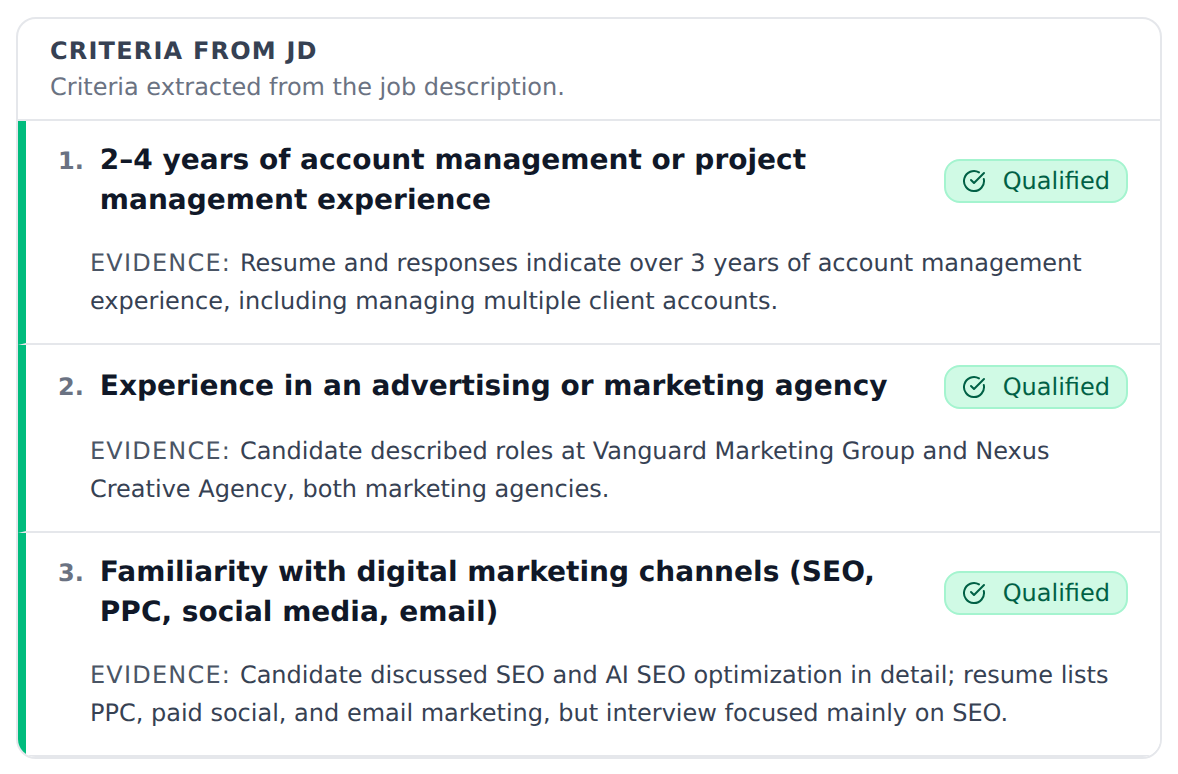
Good questions are only half the job. VeraHire turns the job description into explicit criteria, then scores every candidate's answer against them — with the evidence cited, so the score is auditable instead of a gut feeling.
When you run an operations-manager interview, VeraHire extracts the must-have criteria from your job description — process improvement, people leadership, budget ownership, cross-functional execution — and marks each one Qualified or Not Qualified based on what the candidate actually said. Every verdict links back to the exact moment in the transcript that supports it, so a hiring manager can verify the call in seconds rather than re-listening to a recording.
Compensation snapshot
What does an Operations Manager typically cost?
Pay varies enormously by industry, company size, scope of the P&L, and seniority. Use the range below to sanity-check your budget — then confirm against an authoritative source before you post.
$102,950
median US wage / year (BLS, 2024)
The US median wage for general and operations managers is $102,950 per year (about $49.50 per hour) as of May 2024. The range is unusually wide: most fall between roughly $47,420 and $239,200 (10th–90th percentile), reflecting how much the title varies by seniority — a single-site shift or floor manager sits near the bottom, while a senior operations leader running a large multi-site P&L sits near the top.
Treat these as planning figures. The same job title can mean a $60K supervisor or a $200K+ executive, so anchor your offer to the actual scope — headcount managed, budget owned, and complexity — rather than the title alone.
Source: U.S. Bureau of Labor Statistics, OEWS — May 2024
Avoid these
Common mistakes when hiring operations managers
Most bad operations-manager hires trace back to the same handful of screening shortcuts.
- i.Over-indexing on industry experience. "15 years in our exact vertical" can mask a manager who never actually improved anything. Operating judgment transfers; trivia is learnable.
- ii.Not testing real leadership. Plenty of candidates have "managed a team" on paper but have never made a hard people call. If no question probes it, you won't find out until it's expensive.
- iii.Leaving scope vague. "Operations manager" can mean shift lead or VP-adjacent. If you don't define headcount, budget, and decision rights, you'll mis-level the hire and the offer.
- iv.Mistaking busyness for impact. A candidate who's always firefighting may be the reason the fires keep starting. Hire the one who builds systems, not the one who's heroically indispensable.
- v.Asking only hypotheticals. "How would you improve this process?" rewards good talkers. "Tell me about a process you actually fixed" reveals real operating behavior and results.
- vi.Inconsistent scoring. Without shared criteria, two interviewers rate the same answer differently — and bias fills the gap.
Try it on your role
Generate a free first-round interview for your Operations Manager role
Paste your job description, get a structured operations-manager interview with built-in scoring criteria, and start ranking real candidates in minutes — no ATS required.
FAQ
Hiring an operations manager: quick answers
What skills matter most when hiring an operations manager?
Process improvement, people leadership, and financial literacy — in roughly that order, depending on scope. A strong operations manager can find the bottleneck in a messy workflow, lead a team through change and tough performance calls, own a budget, and execute across functions they don't directly control. Domain knowledge helps, but operating judgment is the part that's hard to teach, so weight it highest.
Does an operations manager need experience in my specific industry?
Often less than people assume. The core operating skills — diagnosing bottlenecks, leading teams, managing a budget, driving cross-functional execution — transfer well across industries. Industry-specific knowledge (regulations, tooling, vocabulary) is usually learnable in weeks to a few months. Prioritize a track record of measurable operational improvement over an exact vertical match, unless your environment is unusually regulated or technical.
How much does it cost to hire an operations manager?
The US median wage for general and operations managers is about $102,950 per year as of May 2024 (BLS), but the range is very wide — roughly $47,420 to $239,200 across the 10th to 90th percentiles. Where a candidate lands depends mostly on scope: headcount managed, size of the budget or P&L, and the complexity of the operation. Anchor your offer to the actual scope of the role rather than the title.
What interview questions actually reveal a great operations manager?
Past-behavior questions beat hypotheticals. Ask for a specific process they fixed and the before/after numbers, an unpopular change they drove to adoption, the hardest people decision they've made, and a time they hit a target with fewer resources than they needed. Listen for measurable results, ownership of hard calls, and systems that outlast them — and probe each answer with a follow-up.