"Tell me about a time you did something for your executive before they asked — and they hadn't realized they needed it yet."
VeraHire Hiring GuidesExecutive AssistantUpdated 2026
How to hire an Executive Assistant in 2026
TL;DR
A great executive assistant is built from judgment, discretion, and anticipation — not from a tidy resume or a list of software. The role is essentially a partnership with one or two leaders, so the only reliable way to hire well is to stop asking how they'd organize a calendar and start asking what they actually did when two VPs both demanded the same Tuesday slot. Below are the 8 interview questions that predict EA performance, what to listen for, the red flags, and how VeraHire scores each one automatically.
The role, honestly
What a great Executive Assistant actually does
The title sounds administrative, but the best EAs run interference, protect attention, and quietly extend the reach of the person they support. Most of the job never shows up in a task list.
On paper an executive assistant "manages a calendar and handles email." In practice they make hundreds of small decisions a day on someone else's behalf — which meeting moves, which request gets a polite no, which fire actually needs the executive and which one the EA can put out alone. They sit on confidential information all day and never leak a word of it, and they hold a mental model of their executive's priorities accurate enough to act without being asked.
The strongest EAs are proactive, not reactive. They see the travel conflict before it becomes a missed flight, prep the brief before the executive realizes they need it, and reorder a chaotic week into something that actually serves the company's goals. They are comfortable being the gatekeeper — saying no on behalf of a leader who can't always say it themselves — without burning the relationships on the other side of the door.
And almost all of it depends on trust. An EA who is technically flawless but indiscreet, or efficient but cold to the people they screen, will fail no matter how clean their inbox looks. You are hiring judgment and temperament first, mechanics second.
Own the calendar and inbox
Triage competing meeting requests, defend focus time, draft and route email in the executive's voice, and surface only what truly needs their attention.
Gatekeep with grace
Say no on the executive's behalf and decide who and what gets through — protecting their time without damaging the relationships on the other side.
Run complex travel and logistics
Book multi-leg trips, anticipate time zones and visas, build detailed itineraries, and rebook calmly when a flight collapses at 11pm.
Partner and anticipate
Hold the executive's priorities in their head, prep briefs and follow-ups before being asked, and stay discreet with sensitive information at all times.
The unique data
The interview questions that actually predict performance
Eight EA-specific questions built around past behavior, not hypotheticals. For each one: what to listen for, the red flag that should worry you, and a follow-up probe to pressure-test the answer.
"Two senior leaders both demand the same 30-minute slot with your executive, and only one can have it. Walk me through how you actually resolved a conflict like that."
"Describe a time you were trusted with sensitive information — layoffs, a deal, a personal matter. How did you handle the pressure to share or react?"
"Your executive said 'protect my Fridays for deep work,' but a persistent director keeps pushing for a Friday meeting. How have you handled that kind of standoff?"
"Your executive's connecting flight is cancelled the night before a board meeting in another city. Tell me about a real travel crisis you've fixed."
"You often write email and messages as your executive. How did you learn to sound like them — and tell me about a time you got the tone wrong."
"Tell me about a time your executive was the bottleneck — late on approvals, double-booking themselves, ignoring something important. What did you do?"
"Describe your most overloaded day — competing deadlines, a shifting calendar, and constant interruptions. How did you decide what got done?"
Evidence-based scoring
How VeraHire scores each answer
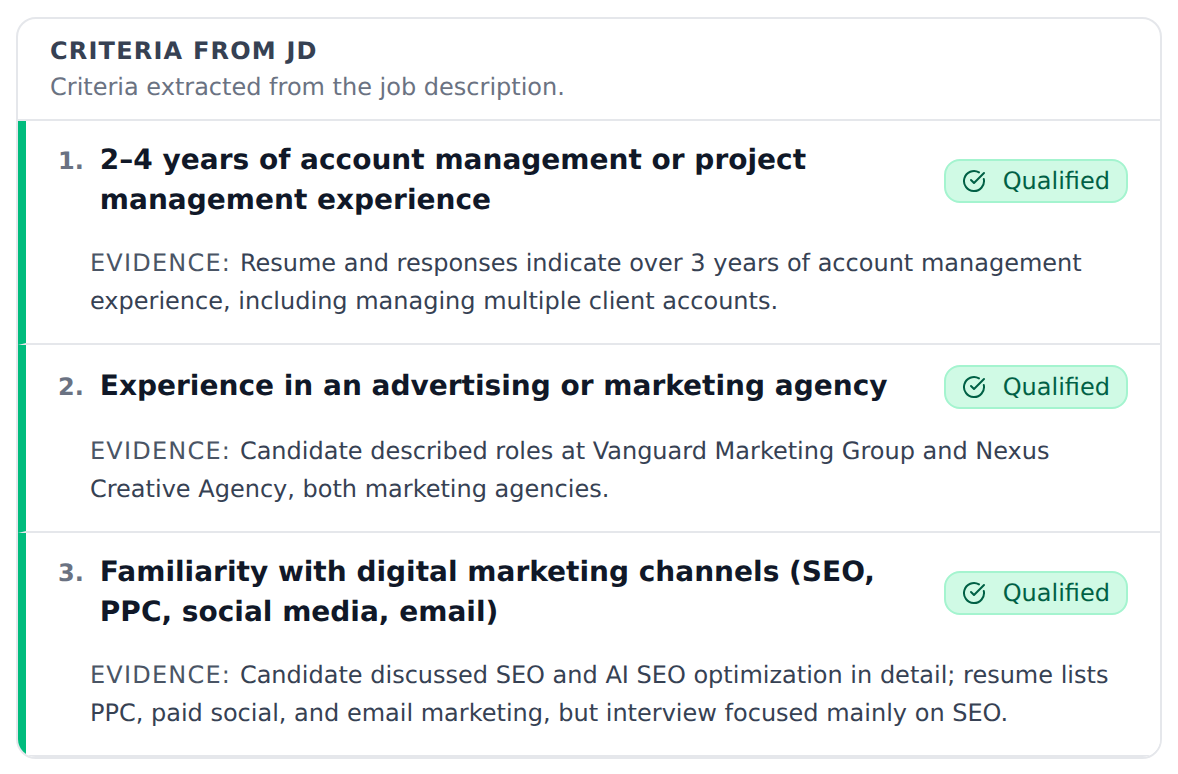
Good questions are only half the job. VeraHire turns the job description into explicit criteria, then scores every candidate's answer against them — with the evidence cited, so the score is auditable instead of a gut feeling.
When you run an executive assistant interview, VeraHire extracts the must-have criteria from your job description — anticipation, discretion, calendar judgment, composure under pressure, written tone — and marks each one Qualified or Not Qualified based on what the candidate actually said. Every verdict links back to the exact moment in the transcript that supports it, so a hiring manager (or the executive themselves) can verify the call in seconds rather than re-listening to a recording.
Compensation snapshot
What does an Executive Assistant typically cost?
Pay varies widely by region, industry, the seniority of the executive supported, and how much the role spans operations or chief-of-staff work. Use the range below to sanity-check your budget — then confirm against an authoritative source before you post.
$63,110
median US wage / year (BLS, 2024)
The US median wage for executive secretaries and executive administrative assistants is $63,110 per year (about $30.34 per hour) as of May 2024. Most fall between roughly $33,450 and $108,550 (10th–90th percentile) — assistants supporting mid-level managers toward the lower end, and those partnering with C-suite leaders at large companies or in high-cost metros toward the higher end.
Treat these as planning figures — actual market rates shift by city, industry, and year, and EAs who take on chief-of-staff, board, or operations duties command well above the published range.
Source: U.S. Bureau of Labor Statistics, OEWS — May 2024
Avoid these
Common mistakes when hiring an EA
Most disappointing EA hires trace back to the same handful of screening shortcuts.
- i.Hiring for software, not judgment. Proficiency in Google Workspace or Concur is table stakes and learnable in days — discretion and anticipation are not. Screen for the hard one.
- ii.Ignoring fit with the specific executive. An EA who thrives with a hands-off founder may flounder with a detail-obsessed CFO. The partnership is the job; test for that chemistry, not a generic profile.
- iii.Never testing discretion. If no question probes how a candidate handles confidential information, you won't find out until they've already shared something they shouldn't.
- iv.Asking only hypotheticals. "How would you organize a calendar?" rewards good talkers. "Tell me about a calendar conflict you actually resolved" reveals real judgment.
- v.Skipping the gatekeeping conversation. An EA who can't say no on your behalf — politely but firmly — will quietly let your calendar and inbox fill back up within a month.
- vi.Inconsistent scoring. Without shared criteria, two interviewers rate the same answer differently — and bias fills the gap.
Try it on your role
Generate a free first-round interview for your EA role
Paste your job description, get a structured executive assistant interview with built-in scoring criteria, and start ranking real candidates in minutes — no ATS required.
FAQ
Hiring an EA: quick answers
What skills matter most when hiring an executive assistant?
Judgment, discretion, anticipation, and calm prioritization matter far more than any specific tool. A great EA reads their executive's priorities, gatekeeps without burning relationships, handles confidential information without fail, and stays composed when the calendar collapses. Software fluency is real but learnable in days — weight temperament and judgment highest.
Does an executive assistant need experience in my industry?
Usually not. The core of the job — managing time, attention, logistics, and a trusted partnership — transfers across industries. What matters more is fit with the specific executive's working style and the complexity of the support, such as board coordination or international travel. Prioritize judgment and adaptability over an exact industry match.
How do I assess discretion and trustworthiness in an interview?
Ask for a real example of handling sensitive information — and watch how they tell it. A trustworthy candidate proves the point without actually disclosing the confidential details, and describes a firm, almost reflexive boundary. If they name names or spill the secret to make the story better, they'll do the same with yours. Probe how they deflect colleagues fishing for information.
What interview questions actually reveal a great EA?
Past-behavior questions beat hypotheticals. Ask for a specific time they anticipated a need before being asked, resolved a calendar conflict between two senior leaders, fixed a travel crisis, and pushed back when their own executive was the bottleneck. Listen for judgment, discretion, and composure — and probe each answer with a follow-up to make sure it's real.