"Tell me about a specific time one student kept disrupting your lesson. Walk me through exactly what you did in the moment and afterward."
VeraHire Hiring GuidesElementary School TeacherUpdated 2026
How to hire an Elementary School Teacher in 2026
TL;DR
Great elementary teachers are made of classroom presence, patience, and the craft of making a hard idea click for a seven-year-old — not certificates and GPA alone. After the state license is verified, the fastest way to find them is to stop asking philosophy questions and start asking for real classroom moments, then score every answer against the same rubric. Below are the 8 interview questions that actually predict teaching success, what to listen for, the red flags, and how VeraHire scores each one automatically.
The role, honestly
What a great Elementary School Teacher actually does
The job title hides how much the work demands. A strong elementary teacher is part instructor, part behavior coach, part diagnostician, part counselor — switching between all four many times before lunch.
On paper an elementary teacher "delivers the curriculum." In practice they run a room of twenty-plus children at wildly different reading and math levels, teach the foundational literacy and numeracy that every later grade is built on, and hold the whole day together — academics, behavior, safety, and emotional weather — usually alone, for six hours straight.
The best ones make a noisy room feel purposeful. They plan a lesson and then read the faces in front of them and change it mid-stream, pull a struggling reader forward without singling them out, and keep a child who finished early genuinely challenged. They build routines kids can trust, communicate honestly with parents who are anxious about their child, and treat every learner as capable. Note that elementary teaching is a licensed profession: nearly every US public-school role requires a bachelor's degree, a completed teacher-preparation program, and a current state teaching license or certification (often with a specific grade-band or subject endorsement), so credential verification is part of hiring, not an afterthought.
Plan and teach the core
Build standards-aligned lessons in reading, writing, and math, then deliver them so a room of mixed levels actually understands — and reteach when they don't.
Manage the classroom
Set routines, expectations, and consequences that keep twenty-plus children safe, engaged, and learning — without running the room on fear or chaos.
Differentiate and assess
Spot who is ahead, who is behind, and why; adjust instruction, small groups, and supports; and use formative assessment to drive the next lesson, not just grade the last one.
Partner with families & care
Communicate honestly and often with parents and guardians, flag concerns early, and attend to each child's wellbeing alongside their academics.
The unique data
The interview questions that actually predict performance
Eight teacher-specific questions built around real classroom behavior, not philosophy. For each one: what to listen for, the red flag that should worry you, and a follow-up probe to pressure-test the answer.
"Your class has children reading two grades below level and others two grades above, in the same room. Describe a real lesson where you taught both."
"Tell me about a time a parent was upset with you — about a grade, a discipline call, or how you handled their child. How did the conversation go?"
"A student in your class still can't decode words their peers read easily. Walk me through how you'd diagnose it and what you'd actually do."
"A child can get the right answer but clearly doesn't understand why. How have you taught for real mathematical understanding, not just procedure?"
"Describe a time you taught a child with an IEP, an English-language learner, or a student whose background differed a lot from yours. What did you change?"
"Tell me about a lesson that flopped — most of the class didn't get it. How did you know, and what did you do next?"
"Elementary teaching is emotionally heavy — hard behaviors, anxious families, kids carrying real burdens. How do you stay steady and avoid burning out?"
Evidence-based scoring
How VeraHire scores each answer
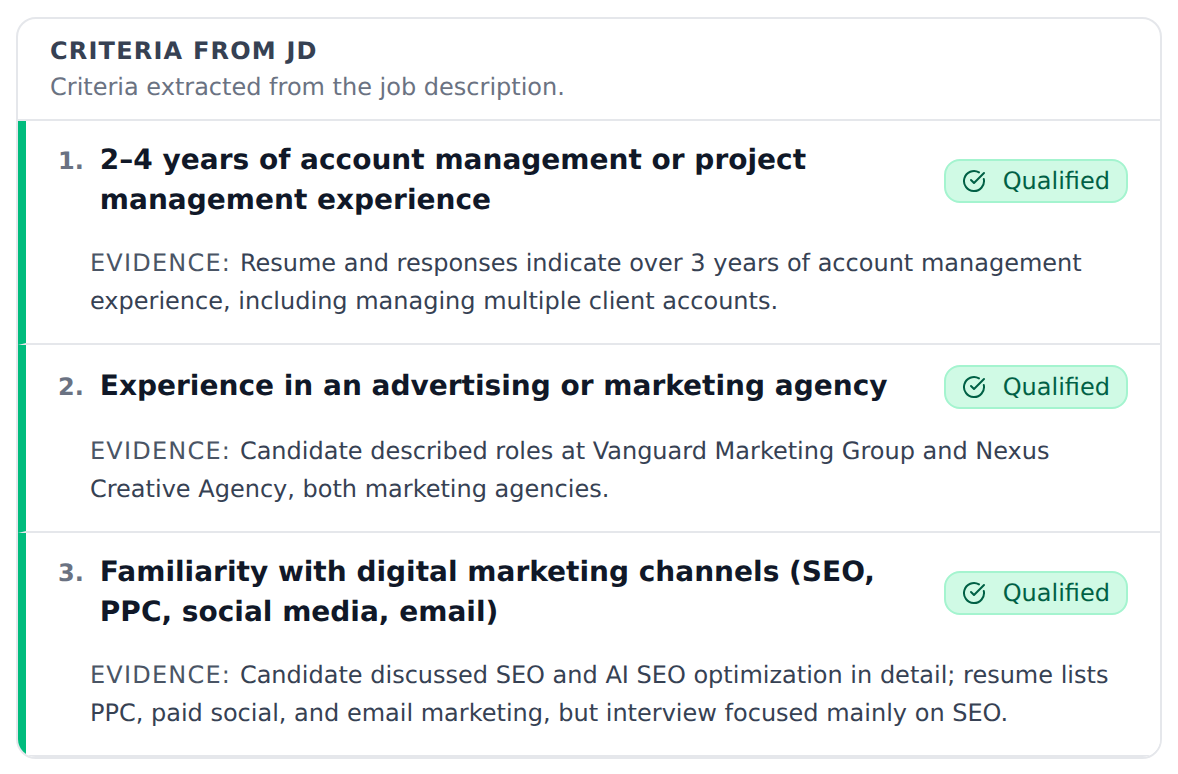
Good questions are only half the job. VeraHire turns the job posting into explicit criteria, then scores every candidate's answer against them — with the evidence cited, so the score is auditable instead of a gut feeling.
When you run an elementary teacher interview, VeraHire extracts the must-have criteria from your posting — classroom management, differentiation, literacy and numeracy instruction, family communication, and required licensure — and marks each one Qualified or Not Qualified based on what the candidate actually said. Every verdict links back to the exact moment in the transcript that supports it, so a principal or hiring committee can verify the call in seconds rather than re-listening to a recording or re-reading a stack of applications.
Compensation snapshot
What does an elementary teacher typically cost?
Pay varies widely by district, state, years of experience, and degree level. Use the range below to sanity-check your budget — then confirm against your district's salary schedule and an authoritative source before you post.
$62,340
median US wage / year (BLS, 2024)
The US median wage for elementary school teachers, except special education is $62,340 per year as of May 2024. Most fall between roughly $46,440 and $102,010 (10th–90th percentile) — early-career teachers and lower-paying states toward the lower end, and veteran teachers with advanced degrees in higher-paying districts toward the higher end.
One important nuance: teachers are almost always salaried on a district pay schedule tied to experience and education, and most work a roughly 10-month contract rather than year-round — so the annual figure reflects the school year, not twelve full months. Treat these as planning numbers; actual offers follow your local salary schedule.
Source: U.S. Bureau of Labor Statistics, OEWS — May 2024
Avoid these
Common mistakes when hiring teachers
Most regretted teacher hires trace back to the same handful of screening shortcuts.
- i.Not verifying certification early. A great interview means little if the candidate lacks the state license or grade-band endorsement the role legally requires. Confirm credentials up front, not after the offer.
- ii.Never screening classroom management. Strong content knowledge collapses in a room the teacher can't lead. If no question tests how they handle disruption, you learn nothing about their hardest hour.
- iii.Ignoring culture and grade-level fit. A gifted upper-grade teacher can struggle with kindergarteners, and a great teacher in one school's culture may flounder in another. Hire for the actual room and team.
- iv.Asking only philosophy questions. "What's your teaching philosophy?" rewards good talkers. "Tell me about a time…" reveals what they actually do when a lesson falls apart.
- v.Over-weighting the demo lesson alone. A polished one-off demo to strangers' kids doesn't show differentiation, family partnership, or how they manage a class over time. Pair it with behavioral evidence.
- vi.Inconsistent scoring across the committee. Without shared criteria, two interviewers rate the same answer differently — and bias fills the gap.
Try it on your role
Generate a free first-round interview for your teaching role
Paste your job posting, get a structured elementary teacher interview with built-in scoring criteria, and start ranking real candidates in minutes — no ATS required.
FAQ
Hiring an elementary teacher: quick answers
Do elementary school teachers need certification or a license?
For public schools, almost always yes. Nearly every US state requires a bachelor's degree, completion of an approved teacher-preparation program, and a current state teaching license or certification — often with a specific grade-band or subject endorsement. Many private and charter schools have more flexibility, and some states offer alternative-certification or emergency-permit routes for shortage areas. Verify the exact credential the role requires, and confirm it before you make an offer.
What skills matter most when hiring an elementary school teacher?
Classroom management, the craft of teaching foundational literacy and numeracy, the ability to differentiate for very mixed levels, honest communication with families, and genuine patience and care for children. Subject content at the elementary level is rarely the limiting factor — how someone leads a room, reads a struggling learner, and stays steady under pressure matters far more.
What interview questions actually reveal a great teacher?
Past-behavior questions beat philosophy. Ask for a specific time they handled a disruptive student, a real lesson where they taught children several grades apart at once, a parent conflict and how it went, and a lesson that flopped and what they did next. Listen for concrete moves, reflection without blame, and high expectations paired with real support — and probe each answer with a follow-up.
How long does it take to hire an elementary school teacher?
It depends heavily on timing. Hiring in the spring and early summer for the coming school year moves on a predictable cycle, while mid-year vacancies and shortage subjects can take much longer. The slowest steps are usually screening a large applicant pool and coordinating committee interviews and demo lessons — running structured, automatically scored first-round interviews up front compresses that significantly.