"Tell me about a time you handled an angry customer who was actually wrong about the facts. Walk me through exactly what you said."
VeraHire Hiring GuidesCustomer Service RepresentativeUpdated 2026
How to hire a Customer Service Representative in 2026
TL;DR
Great customer service reps are made of empathy, judgment, and calm under pressure — not resume keywords. The fastest way to find them is to stop asking hypotheticals and start asking for real past behavior, then score every answer against the same criteria. Below are the 8 interview questions that actually predict CSR performance, what to listen for, the red flags, and how VeraHire scores each one automatically.
The role, honestly
What a great Customer Service Representative actually does
The job title hides how varied the work is. A strong CSR is part problem-solver, part de-escalator, part product expert — switching between all three many times an hour.
On paper a CSR "answers customer inquiries." In practice they absorb frustration without absorbing the blame, find the real problem underneath what the customer first said, and resolve it within rules they didn't write — across phone, email, chat, and social, often several conversations at once.
The best ones make hard interactions feel easy. They acknowledge emotion before they troubleshoot, set honest expectations instead of over-promising, and write clearly enough that a tense thread cools down rather than escalates. They know the product well enough to be trusted and humble enough to say "let me find out" instead of guessing.
Resolve, not just respond
Diagnose the underlying issue, fix it within policy, and confirm the customer is actually satisfied — not just close the ticket.
De-escalate under pressure
Stay calm with angry, confused, or abusive customers, and bring the temperature down without caving on what they can't grant.
Juggle channels and tools
Move fluidly between CRM, ticketing, and knowledge base while handling concurrent chats — without copy-paste errors or dropped threads.
Protect the metrics that matter
Keep CSAT, first-contact resolution, and response times healthy because they understand what each one means for the customer.
The unique data
The interview questions that actually predict performance
Eight CSR-specific questions built around past behavior, not hypotheticals. For each one: what to listen for, the red flag that should worry you, and a follow-up probe to pressure-test the answer.
"A customer writes in furious that they've been on hold an hour and are about to cancel. What are your first two sentences?"
"On chat you're expected to handle three conversations at once. How do you keep quality high across all of them?"
"Describe the tools you used in your last support role — CRM, ticketing, knowledge base — and how you moved between them in a single ticket."
"Which support metrics were you measured on, and which one did you personally move — up or down?"
"A customer asks for an exception and you're not sure it's allowed. What do you do?"
"A customer asks a technical question you don't know the answer to — live, on the phone. What happens next?"
"Support means answering the same question 50 times a day, plus the occasional abusive customer. How do you stay consistent by the 50th?"
Evidence-based scoring
How VeraHire scores each answer
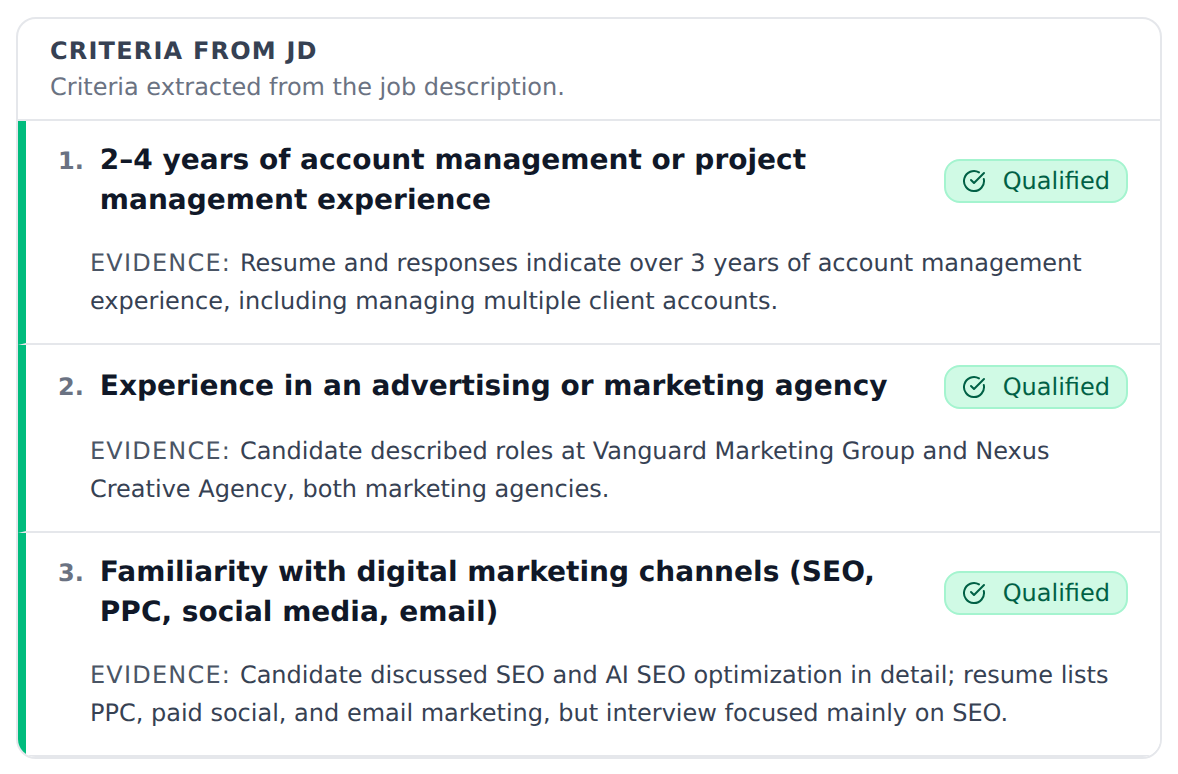
Good questions are only half the job. VeraHire turns the job description into explicit criteria, then scores every candidate's answer against them — with the evidence cited, so the score is auditable instead of a gut feeling.
When you run a CSR interview, VeraHire extracts the must-have criteria from your job description — de-escalation, written tone, tool fluency, judgment — and marks each one Qualified or Not Qualified based on what the candidate actually said. Every verdict links back to the exact moment in the transcript that supports it, so a hiring manager can verify the call in seconds rather than re-listening to a recording.
Compensation snapshot
What does a CSR typically cost?
Pay varies widely by region, industry, channel mix, and seniority. Use the range below to sanity-check your budget — then confirm against an authoritative source before you post.
$42,830
median US wage / year (BLS, 2024)
The US median wage for customer service representatives is $42,830 per year (about $20.59 per hour) as of May 2024. Most fall between roughly $30,700 and $62,700 (10th–90th percentile) — entry-level and high-volume contact-center roles toward the lower end, and specialized, technical, or bilingual support toward the higher end.
Treat these as planning figures — actual market rates shift by city, industry, and year, and remote or offshore models change the math entirely.
Source: U.S. Bureau of Labor Statistics, OEWS — May 2024
Avoid these
Common mistakes when hiring CSRs
Most bad CSR hires trace back to the same handful of screening shortcuts.
- i.Screening on resume keywords. "3 years of support" tells you nothing about how someone actually writes to a frustrated customer.
- ii.Skipping a real writing sample. Most support is now async — if you never see how a candidate writes under pressure, you're guessing.
- iii.Over-weighting industry experience. Product knowledge is teachable in weeks; empathy and judgment are not. Hire for the harder one.
- iv.Asking only hypotheticals. "What would you do if…" rewards good talkers. "Tell me about a time…" reveals real behavior.
- v.Never testing de-escalation. If no question puts the candidate under mild pressure, you learn nothing about their hardest day on the job.
- vi.Inconsistent scoring. Without shared criteria, two interviewers rate the same answer differently — and bias fills the gap.
Try it on your role
Generate a free first-round interview for your CSR role
Paste your job description, get a structured CSR interview with built-in scoring criteria, and start ranking real candidates in minutes — no ATS required.
FAQ
Hiring a CSR: quick answers
What skills matter most when hiring a customer service representative?
Empathy, clear written and verbal communication, de-escalation, sound judgment on edge cases, and comfort juggling tools and concurrent conversations. Product knowledge matters too, but it's far more teachable than temperament — so weight communication and judgment highest.
Does a CSR need prior experience in my industry?
Usually not. Strong support reps transfer across industries because the core skills — empathy, problem-solving, and staying calm under pressure — are the same everywhere. Most product and policy knowledge can be learned in a few weeks, so prioritize aptitude and coachability over an exact industry match.
How long does it take to hire a customer service representative?
For high-volume roles it often runs about two to four weeks from posting to offer, depending on your applicant flow and how fast you screen. The slowest step is usually first-round screening — running structured, automatically scored interviews up front compresses that significantly.
What interview questions actually reveal a great CSR?
Past-behavior questions beat hypotheticals. Ask for a specific time they de-escalated an angry customer, how they handle not knowing an answer live, which support metrics they personally moved, and how they keep quality high across concurrent chats. Listen for honesty, ownership, and calm — and probe with a follow-up on each.