"Tell me about a time your drawer didn't balance at the end of a shift. Walk me through exactly what you did to find the difference."
VeraHire Hiring GuidesBank TellerUpdated 2026
How to hire a Bank Teller in 2026
TL;DR
Great bank tellers are made of accuracy, integrity, and composure at the window — not resume keywords. The fastest way to find them is to stop asking hypotheticals and start asking for real past behavior: a drawer that wouldn't balance, a transaction that felt wrong, a line of impatient customers. Below are the 8 interview questions that actually predict teller performance, what to listen for, the red flags, and how VeraHire scores each one automatically.
The role, honestly
What a great Bank Teller actually does
The job title sounds simple, but it sits on a knife's edge: every transaction is exact money, every customer is watching the clock, and every shift ends with a drawer that has to balance to the penny.
On paper a bank teller "processes transactions." In practice they count and recount cash without looking flustered, follow procedures they didn't write, and stay friendly with a customer at the window while a line forms behind them. They are the face of the branch and its first line of control — the person who can either make a deposit feel effortless or turn a five-minute errand into a complaint.
The best tellers are quietly meticulous. They verify before they pay out, balance their drawer the same careful way on a slow Tuesday as on the first of the month, and notice when something is off — a signature that doesn't match, a customer who seems coached, a withdrawal that doesn't fit the pattern. They are warm with people and unbending with the rules, and they almost never have to choose between the two.
Handle cash with precision
Count, recount, and disburse currency accurately, and balance the cash drawer to the cent at the end of every shift — over and over, without shortcuts.
Process transactions cleanly
Take deposits, withdrawals, transfers, loan payments, and check cashing through the core banking system quickly and without keying errors.
Serve and refer customers
Greet every customer warmly, resolve routine requests on the spot, and spot the moments to refer a checking, savings, or loan product to a banker.
Guard against fraud and stay compliant
Verify identity, watch for forged checks and suspicious activity, and follow BSA/AML rules — including filing CTRs for large cash transactions.
The unique data
The interview questions that actually predict performance
Eight teller-specific questions built around past behavior, not hypotheticals. For each one: what to listen for, the red flag that should worry you, and a follow-up probe to pressure-test the answer.
"Describe a time something about a transaction or a customer felt off. What did you notice, and what did you do?"
"You have a long line, and the customer at your window is angry that a hold was placed on their check. What do you actually say and do?"
"It's the first of the month, the lobby is full, and people are visibly impatient. How do you keep every transaction accurate when you're being rushed?"
"A regular customer you like asks you to back-date a deposit or 'just this once' let a withdrawal through without proper ID. What do you do?"
"Tell me about a time you noticed a customer could benefit from a product — savings, a credit card, an overdraft line — and made the referral. How did you raise it?"
"Walk me through how you handled a transaction you weren't sure was allowed — say a large cash withdrawal or a third-party check."
"Teller work is repetitive deposits and withdrawals, with the rare high-stress moment. How do you stay sharp and consistent through a long, repetitive day?"
Evidence-based scoring
How VeraHire scores each answer
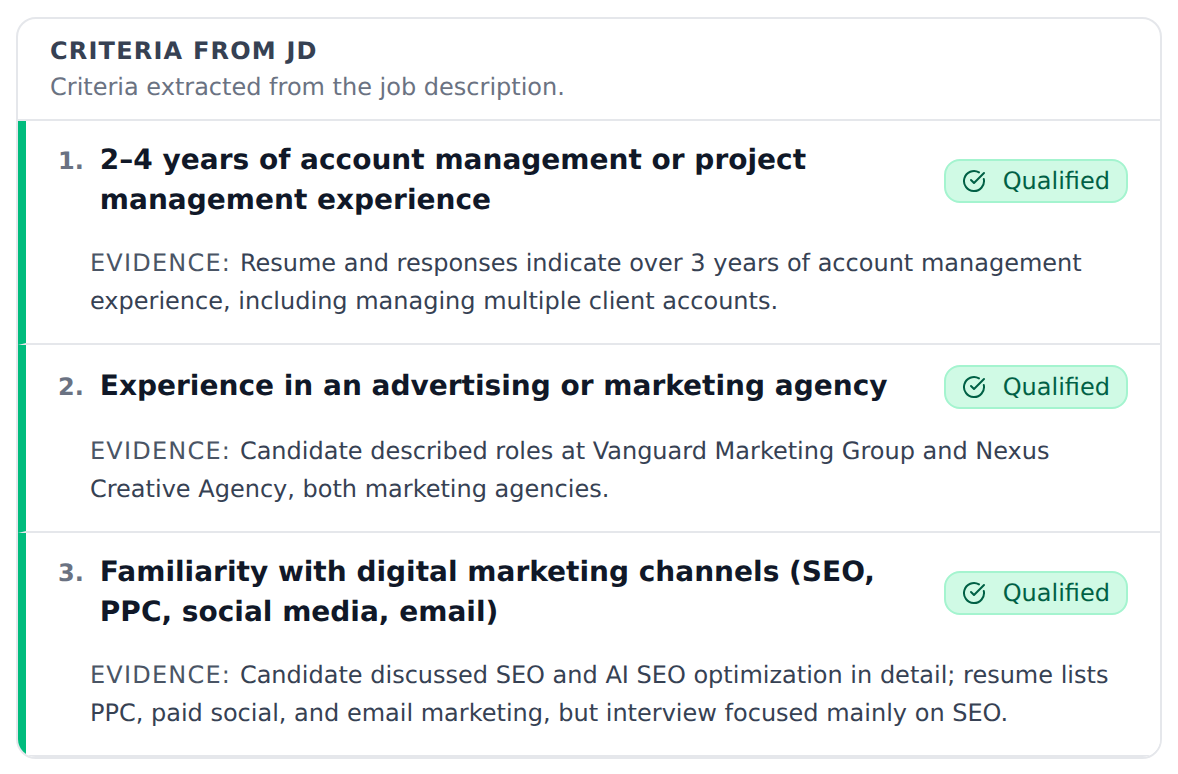
Good questions are only half the job. VeraHire turns the job description into explicit criteria, then scores every candidate's answer against them — with the evidence cited, so the score is auditable instead of a gut feeling.
When you run a bank teller interview, VeraHire extracts the must-have criteria from your job description — cash-handling accuracy, integrity, fraud awareness, composure under pressure, and customer service — and marks each one Qualified or Not Qualified based on what the candidate actually said. Every verdict links back to the exact moment in the transcript that supports it, so a branch manager can verify the call in seconds rather than re-listening to a recording.
Compensation snapshot
What does a bank teller typically cost?
Pay varies by region, institution size, cost of living, and experience. Use the range below to sanity-check your budget — then confirm against an authoritative source before you post.
$39,340
median US wage / year (BLS, 2024)
The US median wage for tellers is $39,340 per year (about $18.91 per hour) as of May 2024. Most fall between roughly $31,270 and $48,270 (10th–90th percentile) — entry-level tellers in lower-cost regions toward the bottom, and experienced or head tellers in major metros toward the top.
Treat these as planning figures — actual market rates shift by city, employer, and year, and many banks add referral incentives and benefits on top of base pay.
Source: U.S. Bureau of Labor Statistics, OEWS — May 2024
Avoid these
Common mistakes when hiring tellers
Most bad teller hires trace back to the same handful of screening shortcuts.
- i.Hiring on friendliness alone. A warm personality is great, but it tells you nothing about whether someone can balance a drawer to the penny under pressure.
- ii.Never testing for integrity. Tellers handle cash unsupervised all day. If no question probes honesty and rule-following, you're trusting a resume.
- iii.Ignoring accuracy under pressure. Anyone can count correctly when it's quiet. Find out how they keep precision when the lobby is full and people are impatient.
- iv.Overlooking fraud awareness. A teller who can't recognize a suspicious transaction or doesn't grasp BSA/AML basics is a real liability at the window.
- v.Asking only hypotheticals. "What would you do if…" rewards good talkers. "Tell me about a time…" reveals how they actually handled cash, conflict, and pressure.
Try it on your role
Generate a free first-round interview for your teller role
Paste your job description, get a structured bank teller interview with built-in scoring criteria, and start ranking real candidates in minutes — no ATS required.
FAQ
Hiring a bank teller: quick answers
What skills matter most when hiring a bank teller?
Cash-handling accuracy, unquestionable integrity, attention to detail, composure under pressure, and warm customer service. Fraud awareness and comfort following procedures matter too. Most banking systems can be taught in a few weeks, so weight accuracy, honesty, and temperament highest — those are the hardest to train.
Do bank tellers need prior banking experience?
Not necessarily. Many strong tellers come from cash-handling or customer-facing roles — retail cashiers, front-desk staff, food service leads — where they proved accuracy and composure. Banks train product knowledge and core systems on the job, so prioritize demonstrated accuracy, integrity, and people skills over an exact banking background.
How long does it take to hire a bank teller?
From posting to offer it often runs about two to four weeks, plus extra time for the background and credit checks most banks require before a start date. The slowest controllable step is first-round screening — running structured, automatically scored interviews up front compresses that significantly.
What interview questions actually reveal a great teller?
Past-behavior questions beat hypotheticals. Ask about a time their drawer didn't balance and how they found the difference, a transaction that felt suspicious, how they kept accuracy when rushed, and how they responded to a customer pressuring them to bend a rule. Listen for accuracy, honesty, and calm — and probe with a follow-up on each.