"Tell me about a time two people you support needed something from you at the same moment, and both said it was urgent. What did you actually do?"
VeraHire Hiring GuidesAdministrative AssistantUpdated 2026
How to hire an Administrative Assistant in 2026
TL;DR
A great administrative assistant is the operating system of a busy office — anticipating needs, protecting calendars, and catching the small errors before they become big ones. You can't read that off a resume's software list. The fastest way to find it is to stop asking hypotheticals and start asking for real past behavior, then score every answer against the same criteria. Below are the 8 interview questions that actually predict administrative assistant performance, what to listen for, the red flags, and how VeraHire scores each one automatically.
The role, honestly
What a great Administrative Assistant actually does
The job title sounds simple, but the work is the connective tissue that keeps an office, a team, and several busy people functioning. A strong assistant is part air-traffic controller, part archivist, part diplomat.
On paper an administrative assistant "provides support." In practice they hold the calendar, the inbox, the travel, the files, the expense reports, and a running mental map of what every person they support actually needs next — usually before that person has asked. They turn a chaotic week into a sequence of things that happen on time.
The best ones are quietly proactive. They notice that two meetings will collide before the invites go out, that a contract is missing a signature, that the visiting client will land at 6 a.m. and need a car. They protect their principals' time without being a wall, write clearly enough that a confusing request becomes a clean action, and handle confidential information as if it were their own. Competence here is invisible when it's working and very loud when it isn't.
Own the calendar
Schedule and defend meetings across people and time zones, resolve conflicts before they happen, and keep the day realistic instead of triple-booked.
Manage documents and data
Draft, format, and proofread documents; maintain filing and records; enter data accurately; and find the one file someone needs in seconds.
Keep the office running
Coordinate travel, expenses, supplies, vendors, and visitors so the day-to-day logistics simply work without anyone having to think about them.
Support several people at once
Juggle competing requests from multiple managers, triage the inbox and phone, and communicate on their behalf with tact and discretion.
The unique data
The interview questions that actually predict performance
Eight administrative-assistant-specific questions built around past behavior, not hypotheticals. For each one: what to listen for, the red flag that should worry you, and a follow-up probe to pressure-test the answer.
"Walk me through the most complicated meeting you've ever scheduled — multiple people, time zones, or a hard reschedule. How did you pull it off?"
"Tell me about a time you caught a mistake in a document, report, or schedule before it went out. How did you spot it?"
"Describe a time you were trusted with sensitive information — personnel, financial, or personal. How did you handle it?"
"Tell me about something you fixed or set up before anyone asked you to — a problem you saw coming."
"Describe the tools you used in your last role — calendar, email, documents, expense or travel systems — and how you used them to keep things organized."
"Tell me about a time you dropped the ball — missed a deadline, booked the wrong flight, sent the wrong file. What happened next?"
"Tell me about a time you had to say no, push back, or deliver an awkward message for someone you support. How did you word it?"
Evidence-based scoring
How VeraHire scores each answer
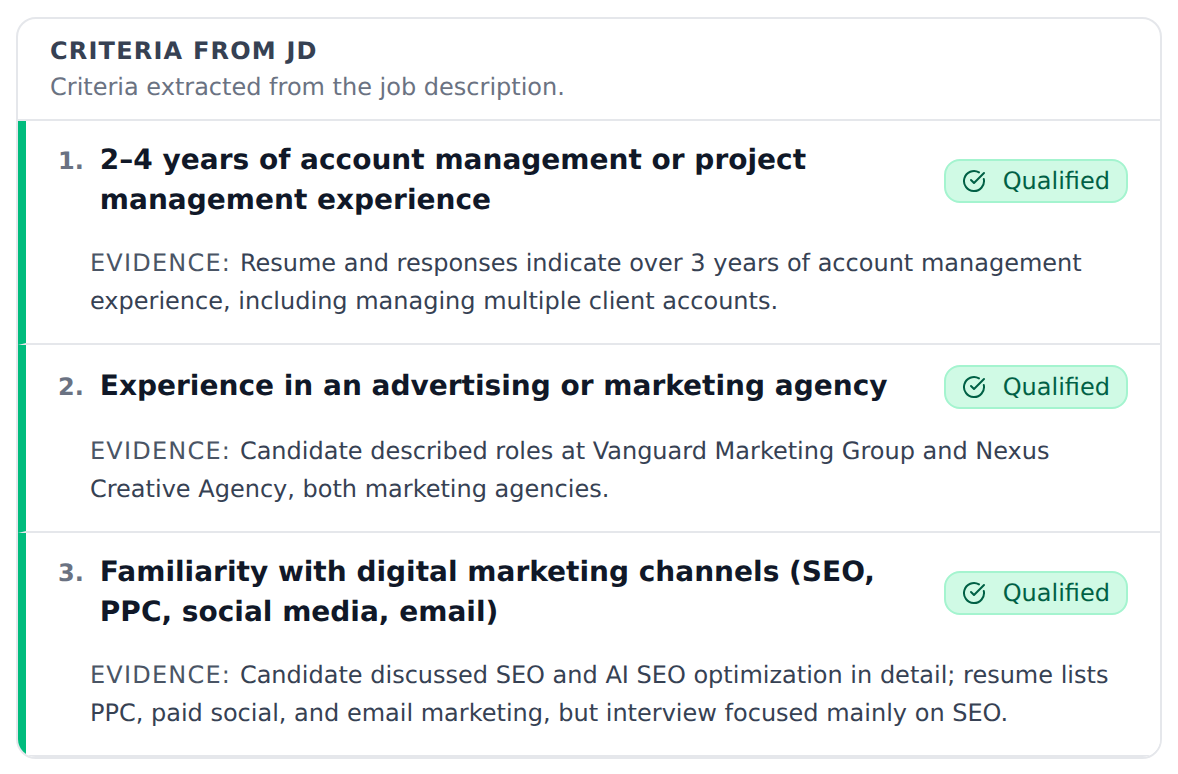
Good questions are only half the job. VeraHire turns the job description into explicit criteria, then scores every candidate's answer against them — with the evidence cited, so the score is auditable instead of a gut feeling.
When you run an administrative assistant interview, VeraHire extracts the must-have criteria from your job description — calendar judgment, attention to detail, discretion, proactivity, tool fluency — and marks each one Qualified or Not Qualified based on what the candidate actually said. Every verdict links back to the exact moment in the transcript that supports it, so a hiring manager can verify the call in seconds rather than re-listening to a recording.
Compensation snapshot
What does an administrative assistant typically cost?
Pay varies widely by region, industry, seniority, and the seniority of the people being supported. Use the range below to sanity-check your budget — then confirm against an authoritative source before you post.
$47,460
median US wage / year (BLS, 2024)
The US median wage for secretaries and administrative assistants (except legal, medical, and executive) is $47,460 per year (about $22.82 per hour) as of May 2024. Most fall between roughly $33,840 and $76,550 (10th–90th percentile) — entry-level and part-time office roles toward the lower end, and senior assistants supporting executives or specialized teams toward the higher end.
Treat these as planning figures — actual market rates shift by city, industry, and year, and titles like "executive assistant" or "office manager" carry their own higher bands.
Source: U.S. Bureau of Labor Statistics, OEWS — May 2024
Avoid these
Common mistakes when hiring administrative assistants
Most disappointing admin hires trace back to the same handful of screening shortcuts.
- i.Hiring on a software checklist. Knowing Excel and Outlook is the floor, not the signal. Judgment, organization, and proactivity are what separate a great assistant from an average one — and none of those appear in a tools list.
- ii.Never testing attention to detail. If no part of your process puts accuracy under real pressure, you learn nothing about the trait the whole job depends on. A short proofreading or calendar exercise reveals more than any resume bullet.
- iii.Underrating discretion. Assistants see salaries, performance issues, and personal matters. Failing to probe how a candidate handles confidential information is how a trust problem walks in the door.
- iv.Asking only hypotheticals. "How would you prioritize?" rewards good talkers. "Tell me about a time two managers needed you at once" reveals what they actually did.
- v.Screening for reactivity, not anticipation. The best assistants prevent problems you'd never have flagged. If you only test whether someone can follow instructions, you'll hire someone who only follows instructions.
Try it on your role
Generate a free first-round interview for your admin role
Paste your job description, get a structured administrative assistant interview with built-in scoring criteria, and start ranking real candidates in minutes — no ATS required.
FAQ
Hiring an administrative assistant: quick answers
What skills matter most when hiring an administrative assistant?
Organization, attention to detail, sound judgment when priorities collide, discretion with confidential information, and clear written communication. Software fluency matters too, but it's far more teachable than judgment and reliability — so weight organization, accuracy, and proactivity highest.
What's the difference between an administrative assistant and an executive assistant?
An administrative assistant supports a team, department, or office with scheduling, documents, and day-to-day logistics. An executive assistant supports one or a few senior leaders, with more autonomy, more confidential exposure, and broader judgment — and typically a higher pay band. Many great executive assistants start as administrative assistants.
How long does it take to hire an administrative assistant?
It often runs about two to four weeks from posting to offer, depending on your applicant flow and how fast you screen. The slowest step is usually first-round screening, because admin roles attract high application volume — running structured, automatically scored interviews up front compresses that significantly.
What interview questions actually reveal a great administrative assistant?
Past-behavior questions beat hypotheticals. Ask for a specific time they handled two urgent requests at once, caught an error before it went out, were trusted with sensitive information, and fixed a problem before being asked. Listen for organization, ownership, and discretion — and probe with a follow-up on each.