"Tell me about the most significant error you caught before it left the building. How did you find it, and what did you do next?"
VeraHire Hiring GuidesAccountantUpdated 2026
How to hire an Accountant in 2026
TL;DR
A great accountant is made of accuracy, judgment, and quiet integrity — not a tidy resume or a stack of certifications. The fastest way to find one is to stop asking what a debit is and start asking for the real time they caught a six-figure error, closed the books under a hard deadline, or pushed back when a number was being massaged. Below are the 8 interview questions that actually predict accounting performance, what to listen for, the red flags, and how VeraHire scores each one automatically.
The role, honestly
What a great Accountant actually does
The title sounds like one job, but the work is several. A strong accountant is part record-keeper, part translator, part early-warning system — moving between all three across the month.
On paper an accountant "maintains the books." In practice they keep a reliable, audit-ready record of everything the business does with money, turn that record into reports leadership and regulators can trust, and flag the problems hiding inside the numbers before they become expensive. Depending on the seat, that can mean staff-level reconciliations and journal entries, a full month-end and year-end close, tax preparation, or the controls and analysis a controller leans on.
The best ones are precise without being slow, and skeptical without being obstructive. They know the difference between a number that ties and a number that's actually right, they apply GAAP to messy real-world transactions instead of reciting it, and they can explain a variance to a sales VP who has never read a balance sheet. A CPA license signals discipline and is often required for audit, public accounting, or sign-off roles — but plenty of excellent corporate and staff accountants are not CPAs, so treat it as one input, not the whole decision.
Keep the books and close them
Own accurate ledgers, reconciliations, and journal entries, and drive a clean, on-time month-end and year-end close that actually ties out.
Report and stay compliant
Produce financial statements under GAAP, support audit and tax filings, and keep the company on the right side of regulators and deadlines.
Analyze and advise
Explain variances, margins, and cash trends in plain language so non-finance leaders can actually make decisions from the numbers.
Protect accuracy and controls
Catch errors before they ship, respect internal controls and segregation of duties, and refuse to let a number be misstated under pressure.
The unique data
The interview questions that actually predict performance
Eight accountant-specific questions built around past behavior, not textbook definitions. For each one: what to listen for, the red flag that should worry you, and a follow-up probe to pressure-test the answer.
"Walk me through your last month-end close. What did you own, where did it get stuck, and how did you still hit the date?"
"A department head insists their budget is fine but you're showing a 20% overspend. How do you walk them through it?"
"Tell me about a time someone — a manager, a client, a founder — pushed you to record something in a way you weren't comfortable with."
"What systems did you live in day to day, and walk me through how you'd reconcile an account that ties in the sub-ledger but not the GL."
"Describe a transaction where the right accounting treatment wasn't obvious. How did you decide, and who did you involve?"
"You're handing off a reconciliation or a set of statements. What's your own check before it goes out the door?"
"Close, a surprise audit request, and a payroll deadline all land in the same week. How do you handle it?"
Evidence-based scoring
How VeraHire scores each answer
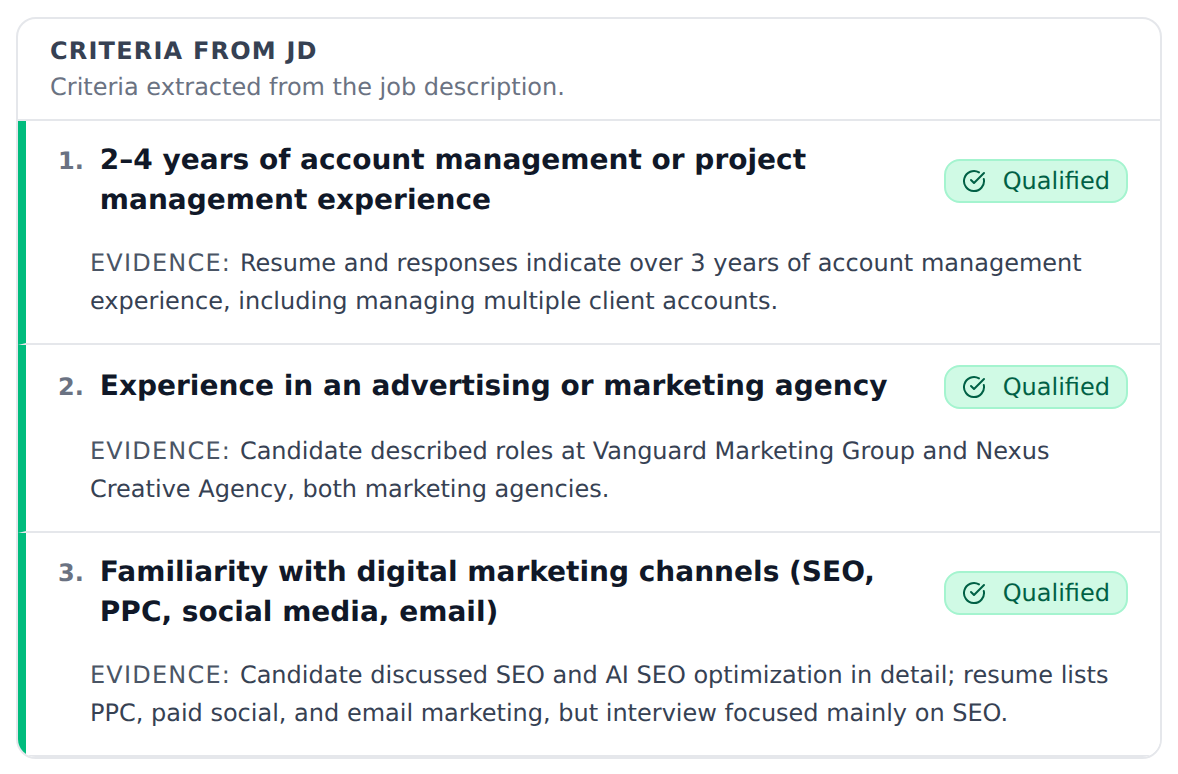
Good questions are only half the job. VeraHire turns the job description into explicit criteria, then scores every candidate's answer against them — with the evidence cited, so the score is auditable instead of a gut feeling.
When you run an accountant interview, VeraHire extracts the must-have criteria from your job description — close ownership, GAAP judgment, ERP and Excel fluency, accuracy, and integrity under pressure — and marks each one Qualified or Not Qualified based on what the candidate actually said. Every verdict links back to the exact moment in the transcript that supports it, so a hiring manager or controller can verify the call in seconds rather than re-listening to a recording.
Compensation snapshot
What does an accountant typically cost?
Pay varies widely by region, industry, CPA status, and seniority. Use the range below to sanity-check your budget — then confirm against an authoritative source before you post.
$81,680
median US wage / year (BLS, 2024)
The US median wage for accountants and auditors is $81,680 per year (about $39.27 per hour) as of May 2024. Most fall between roughly $52,780 and $141,420 (10th–90th percentile) — staff and entry-level roles toward the lower end, and CPAs, senior accountants, and those in public accounting or high-cost metros toward the higher end.
Treat these as planning figures — actual market rates shift by city, industry, and year, and a CPA license, busy-season demand, or specialized industry experience can push an offer well above the median.
Source: U.S. Bureau of Labor Statistics, OEWS — May 2024
Avoid these
Common mistakes when hiring accountants
Most bad accounting hires trace back to the same handful of screening shortcuts.
- i.Requiring a CPA when the seat doesn't need one. Audit, public, and sign-off roles often do — but demanding it for a staff or corporate role needlessly shrinks a strong pool and inflates cost.
- ii.Ignoring the public vs. industry gap. A great public-accounting auditor and a great corporate close owner are different animals; hire for the work the role actually does.
- iii.Never testing for ethics. If no question puts the candidate under pressure to misstate, you learn nothing about whether they'll hold the line on your hardest day.
- iv.Skipping a real accuracy check. Resumes don't reveal who self-reviews; without a practical or behavioral test of accuracy, you're guessing on the one trait the job is built on.
- v.Testing definitions instead of judgment. "What's accrual accounting?" rewards memorizers. "Tell me about a transaction where the treatment wasn't obvious" reveals how they actually think.
- vi.Inconsistent scoring. Without shared criteria, two interviewers rate the same answer differently — and bias fills the gap.
Try it on your role
Generate a free first-round interview for your accountant role
Paste your job description, get a structured accountant interview with built-in scoring criteria, and start ranking real candidates in minutes — no ATS required.
FAQ
Hiring an accountant: quick answers
Do I need to require a CPA when hiring an accountant?
Only sometimes. A CPA license is typically required for roles that sign off on audits, work in public accounting, or file certain regulatory reports, and it's a strong signal of discipline and technical depth. But many excellent staff, corporate, and senior accountants who own reconciliations, close, and reporting are not CPAs. Require it when the seat genuinely needs it; otherwise treat it as one input alongside hands-on close, GAAP judgment, and accuracy.
What skills matter most when hiring an accountant?
Accuracy and self-review, sound GAAP judgment on gray-area transactions, ownership of month-end close, fluency in your ERP and Excel, the ability to explain numbers to non-finance people, and integrity under pressure to misstate. Technical knowledge is teachable; temperament and ethics are far harder, so weight judgment, accuracy, and integrity highest.
Should I hire someone from public accounting or industry?
It depends on the work. Public-accounting backgrounds bring audit rigor, GAAP depth, and exposure to many companies, which suits technical and audit-facing roles. Industry accountants bring close ownership, ERP fluency, and business context, which suits corporate and operational seats. Match the background to what the role actually does day to day rather than assuming one is universally stronger.
What interview questions actually reveal a great accountant?
Past-behavior questions beat textbook definitions. Ask about the most significant error they caught before it shipped, how they ran their last month-end close, a time they were pushed to record something they weren't comfortable with, and how they reconcile an account that ties in the sub-ledger but not the GL. Listen for accuracy, GAAP-grounded judgment, and integrity — and probe with a follow-up on each.